Expanding your business into new markets is a powerful growth strategy. But hiring talent globally introduces a maze of new employment laws, payroll complexities and risks. Many businesses turn to partners like a Professional Employer Organisation (PEO) or an Employer of Record (EOR) like HeroForce to help navigate this.
While both services handle HR functions, they operate differently and the distinction is critical. Understanding the difference between a PEO and an EOR can be the key to unlocking seamless global growth while protecting your business from significant risk.
This guide breaks down the differences and explains why an EOR is the smarter, safer way to build your global team.
What is a Professional Employer Organisation (PEO)?
A Professional Employer Organisation (PEO) offers outsourced HR services like payroll processing, benefits administration and compliance assistance. When you partner with a PEO, you enter into a co-employment relationship.
In this model, the PEO becomes the administrative employer for your staff, while you remain the day-to-day employer responsible for managing their work and performance.
The catch? To use a PEO in a new country, your business must have its own local legal entity established there. This requirement adds significant cost, time and administrative burden to your expansion plans, often defeating the purpose of seeking a simple solution.
What is an Employer of Record (EOR)?
An Employer of Record (EOR) offers a more direct and secure path to hiring international talent. An EOR allows you to hire employees in another country without needing to set up a local entity.
The EOR acts as the legal employer for your team members in that country. They handle all aspects of the employment relationship, from contracts and payroll to taxes, benefits and adherence to local labour laws. You still manage your employees’ daily tasks, projects and performance, maintaining full operational control.
By taking on the full legal responsibility, an EOR eliminates the complexities and risks of global employment, empowering you to hire the best talent, anywhere.
Key differences: PEO vs. EOR
Understanding the key differences between PEO and EOR will help you to determine which solution is right for your business. We’ve developed a comparison table below to help to decide.
Feature
Employer of Record (EOR)
Professional Employer Organisation (PEO)
Local entity
Not required. The EOR uses its own entity.
Required. You must set up your own legal entity.
Employment model
EOR is the sole legal employer.
Co-employment model. You and the PEO share liability.
Risk and liability
EOR assumes full legal employment liability.
Liability is shared, creating a “co-employment” risk.
Best for
Global expansion and hiring talent in new countries.
Outsourcing HR for existing employees in a country where you have an entity.
Compliance
Compliance management handled by the EOR.
Compliance support, but ultimate responsibility is shared.
Speed
Hire and onboard talent in days.
Slow process due to entity setup requirements.
The co-employment risk and why it matters
The co-employment model used by PEOs is one of the biggest differentiators—and a source of significant risk. In a co-employment arrangement, both your company and the PEO are considered employers. This shared status means you also share legal liability for employment matters.
If the PEO makes a mistake with payroll, misinterprets a local law or fails to provide statutory benefits, your business can be held responsible. This exposes you to potential fines, legal disputes and reputational damage in a foreign jurisdiction.
An EOR eliminates this risk. As the sole legal employer, the EOR takes on 100% of the employment liability. They are the ones responsible for ensuring every contract is compliant, every payslip is accurate and every local regulation is met. This clear division of responsibility gives you peace of mind and lets you focus on running your business.
Why an EOR is the smarter choice for global growth
For businesses looking to scale with confidence, an EOR provides a clear advantage. It’s a model built for speed, simplicity and security.
1. Avoid the cost and complexity of entity setup
Establishing a legal entity in a new country is a monumental task. It can take months, sometimes even over a year, and cost tens of thousands of dollars in legal and administrative fees. It requires navigating unfamiliar corporate laws, tax systems and banking regulations.
An EOR bypasses this entire process. You can tap into their existing global infrastructure to hire talent immediately. This saves you an enormous amount of time and money, allowing you to be agile and responsive to market opportunities. Instead of waiting to get set up, you can have your first international employee onboarded in a matter of days.
2. Minimise risk with watertight compliance
Global employment laws are complex and constantly changing. From termination rules and leave entitlements to mandatory benefits and data privacy, staying compliant across multiple countries is a full-time job. A single misstep can lead to severe penalties.
A trusted EOR partner has teams of local experts that live and breathe the employment laws in their respective countries. They ensure every aspect of employment is handled, from drafting contracts to managing statutory contributions and navigating complex termination procedures. This reduces the compliance burden from your shoulders.
3. Hire the best talent, no matter where they are
The modern workforce is global. Restricting your hiring to your local market means missing out on a world of exceptional talent. An EOR breaks down geographical barriers, giving you the freedom to hire the perfect candidate for the role, regardless of their location.This allows you to:
Access specialised skills: Find experts in their field who may not be available in your home country.
Build a diverse team: Foster innovation and a stronger company culture with a globally diverse workforce.
Retain top performers: Keep valuable employees who need to relocate, ensuring you don’t lose institutional knowledge.
When a PEO might still make sense
While an EOR is the strong solution for global expansion, a PEO can still be useful in specific situations. If your business already has an established legal entity in a country and simply wants to outsource HR administration for your existing employees there, a PEO can be a viable option.
In this scenario, you are not looking to expand, but rather to streamline operations in a market where you are already established. However, for any business looking to enter a new market, the EOR model is unequivocally the faster, safer and more efficient choice.
Scale confidently with Employment Hero
Hiring great people is the foundation of business growth. Don’t let borders and bureaucracy stand in your way. An Employer of Record removes the barriers to global hiring, transforming a complex challenge into a simple, streamlined process.
Our HeroForce EOR service empowers you to hire top talent across the globe without the risk and administrative headache. We handle the complexities of international employment so you can build your dream team and scale your business with confidence.
Hiring great people is one of the most powerful ways to grow your business, but it’s also one of the toughest. Finding top talent in a competitive market requires speed, precision and a seamless process that doesn’t bury you in administrative tasks. We get it. That’s why we’ve completely revamped our Applicant Tracking System (ATS) to make recruitment simpler, faster and more effective.
We’re excited to announce a suite of major updates to our ATS, packed with powerful new features designed to streamline your entire hiring workflow. Say goodbye to manual data entry and disjointed systems. Say hello to a single, integrated platform that empowers you to find, manage and hire the right people with confidence.
These updates are built to solve the real-world challenges growing businesses face. Let’s explore what’s live, what’s coming soon and how it will transform your recruitment process.
Build better ads with simplified Job Creation
Launching 1 Dec 2025
Crafting a compelling job ad is an art. It needs to be informative, engaging and structured to attract and match the right talent. Our new simplified Job Creation tool streamlines this process, guiding you through each step to build effective job ads quickly.
The redesigned, 2 step workflow makes creating and posting jobs foolproof, and way faster. It starts with a natural language search – simply input exactly what you’re looking for in simple terms, and our AI will populate all the required fields and build out a suggested job description, optimised for applicant matching. Looking to use your own job description? You can paste it in and the AI will suggest amends to the description to improve clarity and applicant matching. From defining the role and responsibilities to setting salary expectations and required skills, the intuitive interface ensures nothing is missed.
Once you’re happy with your description, the AI will suggest screening questions, whilst keeping a preview of the Job Description in place.
This structured approach helps you create consistent and professional job ads every time, improving the quality of applications you receive. It takes the guesswork out of writing job descriptions, allowing you to focus on showcasing your company culture and the unique opportunity you’re offering.
Post once, reach millions with new Indeed integration
Live now
Sourcing candidates is the first, and often most time-consuming, step in recruitment. To attract a wide pool of talent, you need to post your job openings where candidates are actively looking. That’s why our biggest update is a direct integration with Indeed, the world’s #1 job site.
Gone are the days of manually posting jobs on multiple platforms. With our new integration, you can access:
Free Indeed adverts: all live jobs on careers pages are posted to Indeed as free ads
Integrated screening questions: questions set up in EH are integrated to the Indeed application process for faster shortlisting
One-click applications: Indeed candidates can apply with a single click, increasing applicant volumes
Manage applications in one place: All applications from Indeed flow directly back into your Employment Hero ATS, eliminating the need to track candidates across different systems.
This seamless connection saves you countless hours and expands your reach exponentially. It automates the most tedious part of sourcing, freeing you up to focus on what truly matters: connecting with qualified candidates.
Making it easier for candidates to find you: EH Jobs upgrades
Live now
Our own jobs board, Employment Hero Jobs, has also received significant upgrades, and is now placing more than 1300 candidates into our customers’ jobs every single month. These candidates are placed free of charge with our customers, saving thousands in job ads.
With improved search functionality, job matching and a better user interface, it’s now easier than ever for candidates to discover and apply for roles at your company. This provides another valuable channel for attracting applicants, for free and free of the clutter and ads on traditional jobs boards.
SmartMatch applicant ranking gets a power-up
Live now
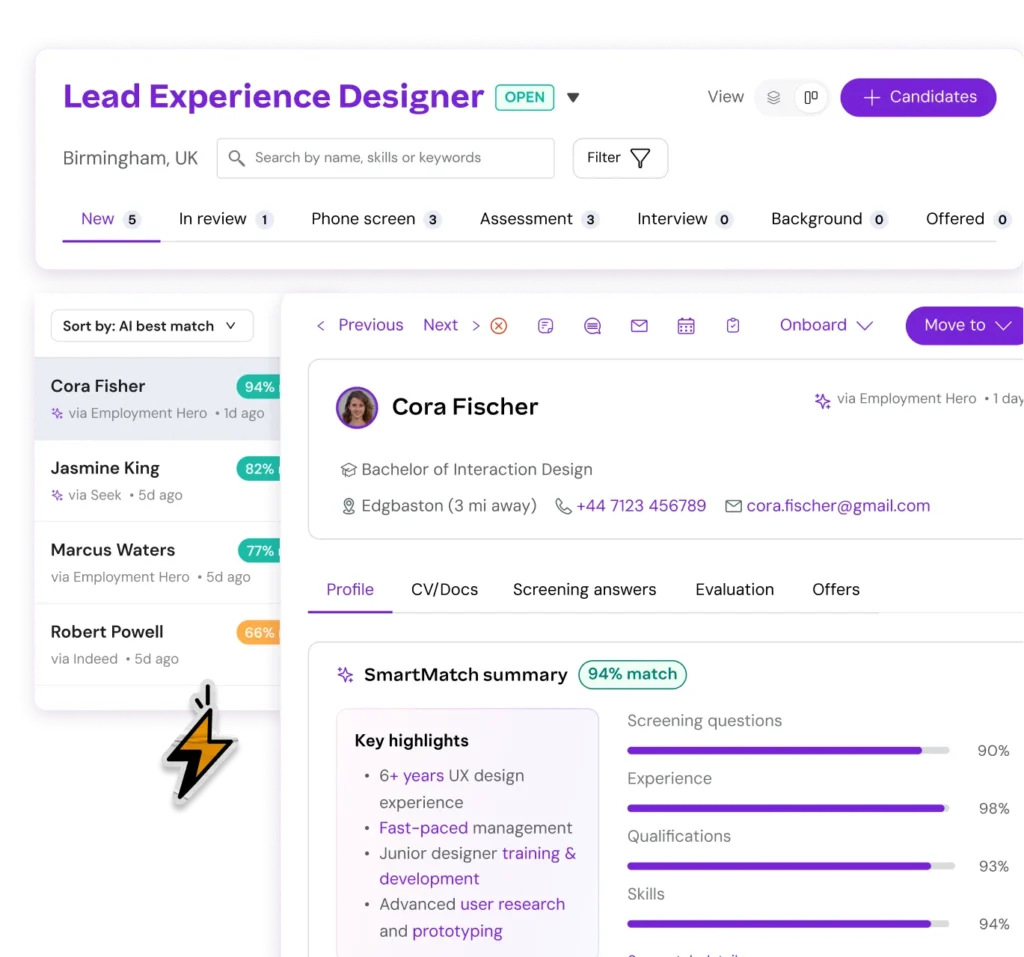
How do you quickly identify the most promising candidates from a large pool of applicants? Our SmartMatch technology does the heavy lifting for you. It automatically analyses resumes and application data, then ranks candidates based on how well their skills and experience align with your job requirements.
This powerful feature allows you to ‘Sort by best match’, to help you prioritise your efforts, ensuring you review the most qualified individuals first.
Upgraded CV parsing means more complete candidate profiles, and detailed summaries of how well individuals match your specific criteria for faster decision making.
Take control with enhanced Applicant Management
Live now
Once the applications start rolling in, speed and clarity matter. A messy or outdated interface does not just slow you down; it puts strong candidates at risk of slipping away. Our modernised Applicant Management experience gives you sharper visibility, faster actions and more confidence as you move candidates through the hiring journey.
We have redesigned the workflow to feel cleaner, smarter and more connected. Whether you are triaging dozens of applicants or refining a shortlist, everything you need sits right where you expect it.
Key updates in the new Applicant Management system include:
Quick action toolbar and action pane: Complete essential tasks without losing sight of the candidate. Notes, activity, communication, scheduling and evaluation now live side by side with the profile, so decisions happen in one place.
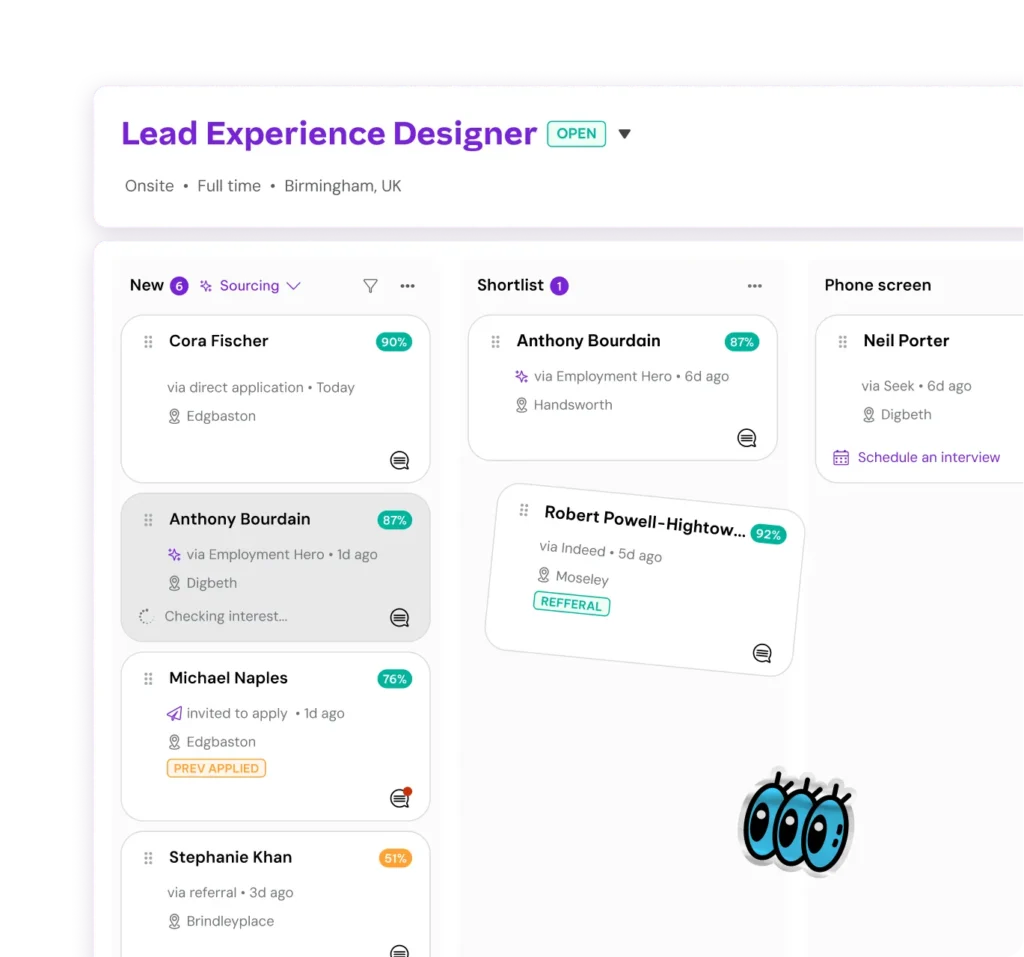
Board view: Switch to a visual overview of your entire hiring process. Every stage. Every candidate. Drag and drop moves them forward with ease, giving you instant situational awareness.
Candidate filtering: Zero in on the people who can truly work for you. Filter by SmartMatch score or screening question responses to quickly exclude dealbreakers and focus your energy where it counts.
Candidate search: Every role now includes a powerful search bar. Find applicants by name, email, skills, certifications, education, past companies, job titles or industries in seconds.
Updated stage view: The refreshed stage view makes shortlisting faster, with SmartMatch scoring and key profile highlights surfaced clearly, plus smoother navigation and quick actions for high tempo workflows.
Updated profiles: Candidate profiles are cleaner and easier to scan, with richer information parsed directly from resumes so you can understand each person at a glance.
This is not just a visual refresh; it is a practical upgrade designed to help you work faster and stay organised. High volume applicant review becomes manageable, focused and far less chaotic, giving every strong candidate the attention they deserve and giving you a hiring process that genuinely keeps up.
Automate first-round interviews with Recruitment Agent
Live now for EOS Unlimited customers
Reduce your hiring bottlenecks with our new Recruitment Agent, your new AI colleague that revolutionises the first-round interview process. Fully integrated into the Employment Hero ATS, this powerful feature automates structured video screening, taking the manual grind off your plate.
Hire faster with pre-vetted shortlists: By automating first-round screening, you cut through the noise and get to a list of interview-ready candidates sooner. Early results show a 50% reduction in screening time, and a week saved on time to hire.
Make smarter, more consistent decisions: By using standardised questions and transparent scoring rubrics for every applicant, it ensures your evaluations are objective and evidence-based. This data-backed approach makes it easier to compare candidates fairly and gives your entire hiring team the confidence to make better, more informed decisions.
Create a fair and scalable process: Every candidate receives the same fair and structured experience, regardless of whether you have 10 applicants or 1,000. This consistency reinforces your reputation as a fair and transparent employer, helping you attract top talent.
Find out more about our Recruitment Agent features.
Start hiring smarter today
The world of work is changing, and your recruitment tools should empower you to stay ahead. The relaunched Employment Hero ATS is more than just a new set of features; it’s a complete solution designed to help you build a winning team. By automating manual tasks, expanding your reach and providing clear insights, we’re giving you the power to hire more efficiently and effectively.
These updates are built to reduce your administrative burden, ensure a great candidate experience and ultimately, help you secure the talent you need to grow your business.
Ready to transform your hiring process? Explore the new features in our Applicant Tracking System and discover a better way to recruit.
Set clear expectations this holiday season with our office closure messages and out-of-office email templates designed for smooth shutdowns.
Every year, as the calendar edges toward December, workplaces quietly prepare for the great annual inbox exodus. It’s one of the few moments in modern work culture where everyone collectively agrees, even if only for a week or two, that rest is not a luxury but a necessity.
And yet, before anyone can properly disconnect, there’s one small ritual that stands between us and true holiday bliss: crafting the perfect “office closed” or out-of-office message.
That’s why we’ve curated a set of updated, easy-to-use templates to help you clearly communicate your downtime, whether your workplace leans buttoned-up, playful or somewhere in between. From general out-of-office messages to Christmas shutdown notices and public holiday reminders, these examples will help you set expectations, reduce confusion and actually switch off.
In this guide, you’ll find:
General out-of-office templates
Office closed for Christmas templates
Office closed for public holidays
Year-end vacation announcements
Tips for managing holiday shutdowns smoothly
Generic Out-of-Office Message Template
Setting an out-of-office reply isn’t just polite, it’s functional. It ensures colleagues know when you’re offline, avoids unnecessary follow-ups and prevents misunderstandings. But it’s also a boundary-setting practice that supports healthier work habits.
Formal
Hi there,
Thank you for your email. I’m currently on leave from [date] to [date] for [reason] and will have limited access to email. Please expect a delayed response.
For urgent matters, contact [colleague name + job title] at [email / phone]. Otherwise, I’ll reply once I’m back.
Kind regards,
[Name]
Informal
Hello!
I’m currently out-of-office and officially offline until [date]. I won’t be checking emails — that’s a promise I’m making for both of us.
In the meantime, here are a few fun facts to keep you entertained:
Koala fingerprints can fool human investigators.
The “code rain” in The Matrix was inspired by sushi recipes.
Earth has more trees than the Milky Way has stars.
For anything urgent, contact [name + job title] at [email / phone]. I’ll be in touch when I return.
Thanks!
[Name]
Office Closed for Christmas Message Template
If your company observes a Christmas shutdown, communicating it early helps prevent confusion and keeps customer expectations clear. Even during holidays, business doesn’t fully pause but clear messaging ensures your team can.
Formal
Hello,
As we approach the festive season, our office will be closed from [date] to [date]. Our team will be taking this time to rest and spend the holidays with family and friends.
Response times may be slower during this period. For general enquiries, visit our [Help Centre link]. For urgent matters, contact [name + job title] at [email / phone].
We’ll return on [date] and will review all messages promptly.
Wishing you a safe and joyful holiday season.
Informal
Season’s greetings!
Our team is offline from [date] to [date], enjoying festive treats and a much-needed break before the new year.
We’ll be back on [date]. For anything urgent, please reach out to [name + job title] at [email / phone], they’re keeping the lights on while we recharge.
Happy holidays!
Office Closed for Public Holidays Template
Use these for any public holiday throughout the year.
Formal
Hello,
Our office will be closed on [date] for [public holiday]. Response times may be slower during this time.
If your query is urgent, please visit our [Help Centre link] or contact us once we return.
Thank you for your understanding.
Kind regards,
[Name]
Informal
Hey there,
I’m currently offline for [public holiday] and will be back on [date].
If you need help urgently, contact [name + job title] at [email]. Otherwise, I’ll respond when I’m back.
Cheers,
[Name]
Annual Year-End Vacation Template
A longer break calls for clarity, especially when you’re stepping away from your inbox entirely.
Formal
Hello,
Thank you for your email.
I’m currently on annual leave and won’t be able to access emails until [date]. For urgent matters, please contact [name + job title] at [email / phone].
I’ll respond when I return.
Wishing you a safe and happy holiday season,
[Name]
Informal
Hello!
I’m off on my long-awaited annual holiday from [date] to [date], and won’t be checking emails during this time.
For anything urgent, my colleague [name] is available at [email].
Wishing you a wonderful festive season and a Happy New Year,
[Name]
Helping You Switch Off, Properly
With these templates in hand, setting holiday boundaries becomes much easier and far more intentional. Download the fact sheet to access our full suite of messages and practical advice for managing shutdown periods with confidence.
Managing leave doesn’t need to be complicated. With the right tools (like Employment Hero), you can streamline processes, support wellbeing and give team members the break they deserve without the administrative stress.
If you’d like an even more opinionated or columnist-style rewrite, I can do that too.
MTD for Income Tax isn’t a technical tax issue. It’s about workflow.
If you understand this and treat it like an operational project, rather than compliance event, you’ll stay calm next April.
This is what chartered accountant and long-time HMRC collaborator Rebecca Benneyworth discussed at the Bookkeepers Summit, and it’s what we discuss in this article.
Here’s what we cover:
MTD: The operational reality
Benneyworth did something unusual for an MTD keynote session: she skipped the theory entirely.
She skipped the slides about legislative history. She ignored the abstract timelines. She didn’t open with “MTD is coming” or show a single chart about digital transformation.
Instead, she went straight to the operational reality accountants and bookkeepers will face in 2026: The real-world decisions, system limits, client behaviours and workflow bottlenecks that HMRC guidance rarely spells out.
Benneyworth has spent close to a decade touring the UK with HMRC, answering hundreds of questions from firms trying to navigate MTD for Income Tax.
If treat it like an operational project, rather than compliance event, you’ll stay calm next April.
Everyone else will be queuing for HMRC support, battling mismatched authorisations, or scrambling to onboard clients who left everything until the last minute.
What Benneyworth shared wasn’t theory. It was the distilled reality of practitioner experience.
The 10 questions she gets asked most often, the hidden operational risks inside the agent services account, the new easement for jointly owned property that finally makes sense, and the three-month window between now and April that will determine whether your 2026 is manageable or miserable.
This is your road map for staying out of the chaos.
1. Who needs to join MTD for Income Tax in April 2026, and how is the income test really calculated?
The single most common point of confusion is also the easiest to fix.
Practitioners still over complicate the £50,000 threshold. They bring in salary, pensions, dividends, and investment income. These are income types HMRC doesn’t even look at for this test.
But once you strip the noise away, mandation rests on just two numbers.
The truth: only two income types matter:
Self employment income (SA103)
Property income (UK + foreign) (SA105 / SA106)
That’s it.
Benneyworth calls them mandated income types. HMRC calls them relevant income. But they are the same thing. And understanding them early shapes your entire 2026 workload.
How the test works:
You look at the 2024/25 tax return.
You total the gross income on SA103 + SA105/106—the figures HMRC can actually see.
If that combined figure is over £50,000, they are in MTD from April 2026.
If it’s below, they’re not, regardless of what their salary or dividends look like.
Once in, they’re typically in for three years unless all mandated income sources cease.
What you should do now:
Build an internal list: every client with SA103 or SA105/106 pages.
Add a column for “expected 2024/25 mandated income”.
Segment clients as: “in from April 2026”, “likely in 2027/28”, or “out”.
Train staff to answer this question the same way,
We only look at your self-employment and property income on the 24/25 tax return. That’s what determines whether you’re in.
Rebecca Benneyworth, Rebecca Benneyworth & Co
This removes most of the noise you get from clients comparing themselves to friends or reading generic online guidance.
2. What about partnerships?
Partnership is one of the most misleading words in the whole MTD for Income Tax conversation.
Clients use it casually, HMRC uses it technically, and it’s easy to mix the two.
Getting this distinction right now prevents you from incorrect scoping your 2026 work—or overlooking clients who are in scope when they think they’re not.
Where partnerships stand today:
Partnerships are not included in the 2026 MTD mandation rules.
They will come in later. Benneyworth’s informed guess: around 2030.
Until then, partners report their share of partnership income via the SA104, as now.
Property “partnerships”—many clients describe joint lets as partnerships. HMRC usually does not.
Quick filter:
Does it have a UTR (Unique Taxpayer Number)?
Do you file a partnership return (SA800)?
If yes, then it’s real partnership and therefore not relevant for MTD in 2026. If no, then it’s jointly owned property and it’s in scope for MTD if income is high enough.
What you should do:
Clearly tag each client: real partnership (SA800) vs joint property.
Don’t assume “property partnerships” are out just because the word is used casually.
Plan 2026 workloads around individuals with SA105, not partnership SA800s.
3. Can clients avoid MTD by incorporating or forming partnerships?
A few accountants and bookkeepers still hope so. Benneyworth’s view was blunt: no, and please don’t try.
Some clients still believe MTD can be sidestepped with a quick incorporation or a “paper partnership.”
The reality: these routes create more admin, more risk, and no genuine escape from future mandation.
Why it doesn’t work:
Incorporation adds more admin, more identity verification, more filings, and more risk.
Partnerships will be included in MTD in the near future.
Your client’s bookkeeping burden doesn’t vanish; it simply moves.
What to advise: push the conversation toward digital record readiness, not legal restructuring:
“If the bookkeeping is clean, MTD is easy. If it’s not, incorporation won’t save you.”
“Entity changes should be driven by commercial and tax reasons—not to dodge quarterly updates.”
4. What do I need before I can start filing quarterly updates?
Filing quarterly updates isn’t simply about software. It’s actually an authorisation and infrastructure question.
The two systems HMRC runs (Caesar and the Enterprise Tax Management Platform, or ETMP) can trip you up if your Agent Services Account isn’t correctly linked.
This is where you could lose weeks unnecessarily, so clarity here is critical.
Your two essentials before filing quarterly updates:
Authority to act for the client. This confirms you’re permitted to manage their tax affairs.
An Agent Services Account (ASA). This is a special HMRC account, linked to your old Agent Online Services login, that lets you access MTD features and client lists.
How the systems connect:
The old system (SA (Self Assessment), CIS, PAYE, etc.) runs on HMRC’s Caesar platform.
The new system (MTD, supporting-agent functionality) runs on ETMP.
Linking the logins allows ETMP to “see” your existing client list.
If you already do the client’s Self Assessment returns, you become main agent without needing new authority.
If the year end return is handled by another accountant, you request authority as a supporting agent (via a digital handshake).
Supporting agents can sign clients up and file quarterly updates without displacing the main agent.
What you should do now:
Log into your ASA and check whether your SA credentials are linked.
Sort out supporting-agent workflows where tax advisers are involved.
Flag clients with outdated DOB/NI info – this will block the digital handshake later.
5. How do I sign clients up for MTD, and in what order?
Sign-up is where the April bottleneck will happen.
Benneyworth was clear about this: “There’ll be nearly a million people trying to sign-up next April—and most of them will wait until the last minute.”
Your ability to stagger sign-ups, triage clients and test early will determine how much pressure your firm feels in 2026.
Here’s how sign-up works. Inside ASA you should:
Go to MTD for Income Tax
Select “Sign-up your client”
Enter name, DOB, NI number
HMRC creates the client’s MTD account on ETMP
From that point, you can submit quarterly updates
You shouldn’t wait. Early sign-ups give you:
Time to fix mismatches (wrong DOB, NI, name spellings).
Access to HMRC support while queues are manageable.
A chance to test year-end functionality before it becomes mandatory.
What to do now:
Build a staged sign-up schedule:
digital-ready clients first
high-risk clients next
behavioural laggards last
Create an internal sign-up checklist.
Start testing the sign-up process now with a handful of safe clients.
6. How many submissions will I be making—and how do penalty points work?
The number of submissions per client is straightforward once you map it to the existing Self Assessment structure. Where you might lose clarity is on penalty points, especially the “one point per quarter” rule that’s easy to miss.
Understanding this now allows you to build a predictable compliance calendar before clients start missing deadlines.
Good news: There’s a grace period, previously referred to as the “soft landing” in the days of MTD of VAT being introduced back in 2019.
This means no penalty points will be issued for late quarterly updates during this initial transition. This gives you and your clients valuable time to adapt without the pressure of immediate penalties.
Submissions mirror the Self Assessment “shape”, in that:
Each trade has its own quarterly update
Property income is one quarterly update
Foreign property, currently included within SA106, is its own quarterly update
So, a client with:
one trade = one quarterly update
one trade + property = two updates
three trades = three updates
It’s the same structure as SA103s today.
Penalty points is where there’s confusion:
You cannot get multiple penalty points in one quarter.
One quarter = one potential point, no matter how many submissions you miss.
It’s the pattern of non-compliance across the year that matters.
What to do now:
Map the “submission count” for every MTD client.
Identify which clients will need consolidation workflows.
Build a quarterly compliance calendar with internal cut-off dates.
Educate clients early about the penalty model. Consistency matters more than perfection.
Joint property is the area that caused the most confusion, until HMRC introduced a long-awaited easement.
This change removes the unworkable requirement for every expense to be digitally split all year.
Getting comfortable with the new income-quarterly/expenses-year-end structure will save you huge time.
The easement (co-designed by HMRC + practitioners) is as follows. During the year, each joint owner:
Records and submits their share of the income only
At year end they must:
Gather all property expenses
Allocate them between owners
Submit the final expense update in one go
This avoids the unworkable scenario where every £3 sink strainer has to be individually split and recorded digitally by each owner.
Important limits are as follows:
Applies ONLY to jointly owned property
Does NOT apply to property someone owns outright
Clients with larger portfolios should be pushed toward specialist landlord software
What to do now:
Add an “easement flag” to your practice list.
For 1–2 property owners: plan to use the easement.
For multi-property landlords: recommend specialist software early.
Educate clients clearly: “Quarterly = income only. Year-end = expenses as one combined update.”
MTD is flexible on tools, but not on process.
You can mix software, spreadsheets, and bridging, as long as digital links exist. The real challenge is avoiding a “tech long tail” where every client uses something different.
The simple rule is that you can use the following as long as digital links exist:
Cloud accounting software
Desktop software
Spreadsheets
Specialist landlord tools
Mixed stacks (e.g., one provider for quarterly, another for year-end)
Copy-paste of totals is not allowed, as per digital linking rules.
What this means for your stack:
You don’t have to standardise on a single system.
You can mix bookkeeping software, bridging tools and professional tax software.
You can test year-end functionality with multiple products during 2025.
What to do now:
Audit every client’s current software
Define 2–3 “MTD-approved stacks” your firm will support
Avoid long tail complexity where every client uses something different
Ask vendors about their MTD year-end roadmap—don’t assume it exists yet
For many bookkeepers and accountants, the year end under Making Tax Digital (MTD) is the stage that brings the most uncertainty and concern.
While the workflow itself will feel familiar to anyone used to Self Assessment, the tools and processes are evolving, so it’s natural to have questions about how everything fits together.
Understanding the intended sequence, from quarterly updates to final adjustments and client approval, will help you approach the transition with confidence and clarity.
The intended process is as follows:
Quarterly updates lead to cumulative totals for the year
Year-end adjustments could be as follows:
Journals
Capital allowances
Accruals/prepayments
Add other income (employment, pensions, dividends, etc.)
Client approval
Finalisation of the digital records to tax return submitted
There is no fifth “quarter”. Year-end is a crystallisation of the year’s data.
If you sign-up at least one client before March 2026, you get to test the year-end process in a real environment before it matters.
What to do now:
Choose one to three pilot clients.
Map your year-end workflow: which parts happen in bookkeeping software, which in tax software.
Standardise your client approval process.
Train staff so the change feels evolutionary, not revolutionary.
If there was one consistent theme in Benneyworth’s advice, it’s this: start now, in small steps.
The next 18–24 months matter more than the deadline. Your key actions should be:
Build your MTD client population list.
Segment and prioritise who you’ll move first.
Fully set up your ASA and authorisations.
Choose your software stack per client type.
Train internal staff using pilot cases.
Use 2025 to run at least one end-to-end rehearsal.
Early preparation is the single biggest predictor of a smooth 2026.
Leaving this until next April guarantees long HMRC queues, unforced errors, and a miserable first year.
Benneyworth’s final point was the most important one: the firms that spend time preparing now will find April 2026 manageable. The ones that wait will drown.
Here’s what that looks like in practice, if you start in 2026:
January 2026:
Build your MTD client list (SA103 + SA105/106 only).
Link your Agent Services Account to your old login.
Sign-up 2–3 pilot clients while HMRC queues are quiet.
Run at least one full end-to-end test with a real client.
February 2026:
Train your team using the pilot cases as templates.
Finalise your software stack and document internal workflows.
Build your quarterly compliance calendar with internal cut-offs.
Communicate the change to clients before HMRC does.
The deadline is April 2026. It’s rapidly approaching.
Benneyworth’s closing message cut through the noise: “MTD doesn’t overwhelm well-prepared firms—it only overwhelms late ones.”
Mandated income rules are clear once you strip away the distractions.
Partnerships and joint property aren’t as complicated when you separate HMRC’s definitions from everyday language.
Authorisation and ASA hygiene matter more than software choice. Early sign-ups give you room to fix mismatches before the rush.
Year end is familiar, but only if you’ve tested your tools.
By investing now, by building lists, segmenting clients, cleaning ASA records, and running real tests with pilot cases, you’ll enter April with confidence, clarity, and control.
MTD for Income Tax is a workflow project.
Treat it like one.
Start early. Test early. Scale calmly.
And make January count.
The accountant’s guide to Making Tax Digital for Income Tax
Download this free interactive guide to developing your practice approach to Making Tax Digital for Income Tax.
At the Institute of Chartered Bookkeepers (ICB) Bookkeepers Summit, CEO Amy Copeland described bookkeepers as human Application Programming Interfaces (API): the connective layer linking the messy, mismatched systems that small businesses depend on but rarely understand.
Amy said, “Bookkeepers have become the API. The thing that connects two bits of software so that data can flow. And we’re saying bookkeepers are doing that for everything that matters”
And she’s right.
“Human API” is a great description of the work bookkeepers do every day. In this article we explore the concept. Here’s what we discuss.
The human API: The invisible infrastructure small businesses run on
As bookkeepers, you’ll carry out tasks like:
Translating HMRC’s digital vision into something clients can act on.
Connecting VAT deadlines with a sole trader’s forgotten Government Gateway login.
Catching cash flow danger before the business owner even realises their supplier raised prices six months ago.
You sit at the intersection of data, behaviour, compliance, and chaos—and you make an ecosystem work that could collapse without you.
If any part of that ecosystem breaks, it lands on you first.
And when it works, it’s usually because you’ve held the pieces together long enough for everyone else to catch up.
This is what “human API” really means. It’s the real work happening every day in Britain’s small businesses.
Why “human API” matters right now
Small businesses are under pressure from every direction, and bookkeepers field almost all of it.
For example, late payments are a systemic threat.
In the UK, an estimated 38 small businesses go under every single day because cash flow dries up. Bookkeepers see those early warning signs before anyone else.
This number comes from UK Small Business Commissioner research, published alongside the government’s Small Business Plan and commissioned by the Department for Business & Trade (DBT):
The research also says:
Late payments alone costs the UK economy £11 billion a year.
Small-business owners spend, on average, 86 hours chasing debt per year. These are hours that produce nothing but stress and lost momentum.
So, who helps businesses face the consequences when the system breaks?
Not policymakers.
Not software vendors.
Not even accountants.
It’s bookkeepers.
You’re the ones who get the panicked emails when invoices go unpaid.
You’re the ones who explain why the supplier raised prices or why the tax pot is too low.
You’re the ones who quietly fix the financial admin that business owners either avoid or don’t understand.
This is why the human API metaphor is a structural reality.
And that’s why it was so significant to listen to Emma Jones, the UK Small Business Commissioner, speaking at the Bookkeepers Summit main keynote.
I simply could not have done it without my bookkeeper. She became the finance pillar of the whole business.
Emma Jones, UK Small Business Commissioner
Emma’s message was clear: bookkeepers aren’t a peripheral part of the small-business ecosystem. They are the people holding it together when cash flow breaks, when admin overwhelms owners, and when payment delays threaten survival.
At the Regional Investment Summit in October 2025, the Chancellor announced the government wants to reduce the admin burden on small businesses by 200 hours.
That only happens if bookkeepers can eliminate friction in the systems they’re forced to mediate, such as MTD ambiguity, inconsistent data, late payments, client misunderstandings, and endless reconciliations between tools that don’t communicate with each other.
In other words:
Small businesses aren’t drowning in complexity because they lack software.
They’re drowning because everything around them is fragmented.
Bookkeepers keep it flowing.
At a moment when small business confidence is fragile, late payments are rising, and digital adoption is being pushed harder than ever, your human API role makes you part of the critical infrastructure in the small-business economy.
A human API case study from the UK small business commissioner
Emma Jones further shared a story that captures the human API role in practice.
Before taking on her current post, she ran several businesses and did what many founders do: kept the books herself, cross-checking bank balances and chasing invoices between emails. It worked until growth raised the stakes and the risks became real.
A mentor gave her the advice every bookkeeper already understands: Bring in a bookkeeper before something breaks.
So, she hired one part-time. That person quietly became the financial backbone of the business.
They managed credit control, cleaned data, kept everything compliant, and eventually steered the company through two major transactions: an investment round and later, a sale to a US private equity firm.
This is the human API in action. The bookkeeper didn’t just “do the books.”
They connected the operational reality, the compliance demands, the investor expectations, the data, the decisions, and the cash flow—linking parts of the business that never speak to each other unless a human steps in.
Emma’s story makes one thing unmistakably clear: a business can go a long way without an accountant, but not without a bookkeeper acting as the human API.
5 key insights from the Bookkeepers Summit
Bookkeepers sit at the centre of how small businesses experience technology, regulation, and day-to-day financial pressure.
Across the keynotes, panels, and practitioner discussions of the Bookkeepers Summit, a consistent pattern emerged: Bookkeepers operate at a different altitude, carry a different kind of load, and shape the success or failure of digital change in overlooked ways.
The Summit didn’t just celebrate the profession. It revealed how deeply bookkeepers shape the flow of data, compliance, and decisions inside small businesses.
The following themes stood out.
1. Bookkeepers operate at a different altitude
The Bookkeepers Summit made the contrast with accountants unmistakable.
Bookkeepers operate in the day-to-day flow of a business, not in quarterly review cycles. You see the micro-signals that determine whether a small business is stable or sliding, such as:
Cash-flow tightening in real time
Supplier price creep
Client behaviour changes
Early signs of disorganisation or burnout.
These are the things that never show up in a set of monthly statements until it’s too late.
Emma Jones’ opening story captured this perfectly.
The first person who stabilises a growing business isn’t the accountant doing compliance work. It’s the bookkeeper who acts as the connective layer between the owner, operations, and finances.
Bookkeepers aren’t “junior accountants”. You do a different job entirely.
You’re inside the workflow every day.
You see numbers as they form, not after the fact.
You make judgment calls in the moment because you’re close to what’s happening—who’s paid, who hasn’t, what’s missing, what’s unusual.
That proximity is what makes bookkeepers the connective tissue of small businesses.
It also explains why your needs around technology and AI aren’t the same as those for accountants. Your value must show up in the daily flow, not in end-of-month tasks.
2. Bookkeepers are being forced into the regulatory translation role
Between HMRC’s digital ambition and the lived reality of MTD, bookkeepers are the ones bridging the gap.
Amy Copeland said it outright: bookkeepers connect HMRC’s “amazing vision” with the fact that “sometimes you still have to write to HMRC for an agent code.”
Every question clients ask about landlords, quarterly updates, digital records, penalties, or what’s changing versus staying the same, lands with bookkeepers first, not HMRC. It’s unpaid translation work, and it can be relentless.
This is part of the human API load and a unique skillset you must develop, turning regulatory noise into something a real person can act on.
3. MTD: Digital change succeeds or fails at the bookkeeping layer
In a Making Tax Digital update at the Bookkeepers Summit, HMRC’s Director of MTD Craig Ogilvie was blunt about the scale of what’s coming.
Craig called MTD for Income Tax “the biggest thing I’ve ever done”. He explained that it was bigger than the furlough scheme or Brexit systems—and said the real change isn’t just technical. It’s “societal”. Bookkeepers, agents, and accountants will have to work differently to the old Self Assessment norm.
“We’ve re-platformed our tax system and built new APIs so the software market can operate properly… But MTD is in safe hands with bookkeepers.”
Craig’s message to the room was clear:
Around 200,000 unrepresented taxpayers need support in the new system.
Clients over £50,000 income should be signed up early, not in a last-minute rush.
“Good bookkeeping has to be in place from the start of the year” if quarterly updates are going to work in practice.
In other words, MTD isn’t simply about policy. Bookkeepers play a crucial role in driving behavioural change.
For example, you can stop confusion around HMRC agent service accounts (the special logins agents use to manage client tax affairs), handling digital exemptions, and supporting clients who might otherwise delay action until problems escalate.
MTD exposes how dependent the system is on the human API layer you provide as a bookkeeper.
4. Bookkeepers already shape technology: Vendors follow you, not the other way around
Bookkeepers decide what tools survive, which workflows make sense, and ultimately, what gets adopted. You are the tester and validator, finding the first point of friction, or the first point of failure.
If a tool creates more confusion or more admin, it dies.
If a tool removes friction, it spreads fast—usually through bookkeeper networks, not via marketing campaigns.
You don’t adopt technology because it’s smart. You adopt it because it removes chaos.
Even on the Bookkeepers Summit exhibition floor, the pattern was clear: vendors chase bookkeeper workflows.
This is more evidence of the human API effect. The ecosystem moves to where bookkeepers need to remove friction.
5. Your role is expanding into leadership, strategy, and tech advisory
The bookkeeping profession is evolving faster than its training.
New pathways you’ll need to become familiar with are:
Leadership of teams
Change management
Strategy
Tech advisory and oversight.
This shows that the human API element is expanding further into a “human in the loop” intelligence layer.
Bookkeepers are no longer the last step in the chain. You’re becoming:
Early signal detectors
Workflow designers
Compliance interpreters
Trusted strategic guides for small businesses.
Bookkeepers are carrying more of the daily financial load than ever before—more clients, more real-time expectations, more admin, and more disconnected systems.
That’s why the conversation naturally turns to AI: not as a replacement for your judgment, but as the only realistic way to reduce rising operational strain without lowering your standards.
AI: Automation of chaos, not expertise
If bookkeepers are the human API, then AI has one purpose: to remove the friction created by systems that don’t talk to each other, not replace your expertise and oversight that holds everything together.
AI that promises anything else is a distraction.
Right now, you might spend too much time acting as a translator between mismatched systems.
You’re looking at HMRC portals, invoices, bank feeds, client behaviours, spreadsheet imports, late payments, mismatched data, and tools that were never designed to talk to each other.
As a human API, you carry the emotional and operational load of keeping clients’ financial lives running even when systems don’t connect.
The moment you give AI or automation even a small part of that load, the value of your judgment becomes clearer, not smaller.
Based on the Summit, three things stand out:
1. AI should give bookkeepers their 86 hours back
Many of the time-consuming issues that eat into the 86 hours chasing debt per year, and that send make 38 businesses a day go out of business, can now be automated with the right AI tools.
These include:
Late payment recovery
Invoice chasing
Client clarification loops
Email archaeology
Manual checking and re-checking
Reconciliation of errors caused by clients, not systems.
AI should automate the drudgery, not the judgment, which sits firmly with you.
AI can replace the broken middleware around bookkeeping: the duplicate imports, mismatched portals, missing documents, and manual corrections that shouldn’t exist in the first place.
If AI can compress those 86 hours into 8, that’s impact and value.
In an example of how effective this time saving could be, Accrual World implemented Sage Accounting and AutoEntry to automate data entry and document processing—saving a full day per week on manual admin.
This allowed the team to focus on higher-value advisory work and proactive client support, rather than repetitive admin.
Automation didn’t just save time. It enabled Accrual World to onboard new clients directly onto the cloud and plan workloads more effectively.
2. AI should stabilise data before it reaches humans
Bookkeepers shouldn’t be cleaning up:
Badly scanned invoices
Inconsistent dates
Duplicate transactions
Missing notes
Miscategorised expenses
Broken imports
Half-complete data pushed through APIs.
You’re forced to fix these because the digital ecosystem is fragmented.
A good AI system becomes an early warning tool:
Flagging anomalies
Correcting obvious errors
Structuring messy inputs
Aligning data across tools.
It makes the human API layer cleaner, not heavier. For example: a system that auto-flags duplicate transactions before they clog your bank feed cleanup, so you spend less time firefighting errors and more time focusing on higher-value judgment work.
3. AI should enhance, not overwrite, human judgment
Bookkeepers are expanding into leadership, change management, and tech advisory. Your value is highlighted in:
Interpreting signals
Advising small-business owners
Spotting early risk
Guiding adoption.
AI should surface patterns and predictions, but the interpretation—the part that affects real people—stays human.
You don’t need AI that does your job. You need AI that amplifies your role.
Evolution from human API to human-in-the-loop intelligence
If bookkeepers have become the human API for Britain’s small businesses, the next step isn’t automation. It’s more intelligence.
It’s not AI-focused, but a human-in-the-loop intelligence: a model where AI handles the friction and the bookkeeper handles the meaning.
Imagine opening an MTD quarterly update where 70% of the cleanup is already done.
Imagine opening a quarterly update where not only 70% of the cleanup is already done, but duplicate transactions are flagged, anomalies surfaced, missing descriptions inferred—and your job is simply to interpret what matters.
This is already happening in the sector.
ICB’s move into leadership, strategy, change management, and tech advisory is a recognition that bookkeepers now sit closer to the truth of the business than anyone else.
You see early signals: late payment stress, cash flow drift, pricing mistakes, supply chain pressure, and client behaviours that quietly erode resilience.
AI can surface patterns
AI can clean the data
AI can reduce the 86 hours of wasted admin that cripple small businesses.
But only bookkeepers can interpret those signals and turn them into better decisions.
This is where the human API becomes a force multiplier.
When bookkeepers are supported, rather than sidestepped by AI, the entire small-business ecosystem becomes strong.
That’s how you get to the government’s ambition: if every small business grows by just 1% a year, Britain adds hundreds of billions to the economy by 2030.
The path to that isn’t policy.
It isn’t product.
It’s authentic intelligence. Human first, AI-assisted, API-powered.
5 things bookkeepers should do next: your human API checklist
If bookkeepers are becoming the human API for small businesses, your next step is to make that role intentional, rather than accidental.
Here’s a simple way to start.
1. List the tasks you only do because systems don’t talk to each other
Write down the jobs that exist purely because data is fragmented—for example:
Manually importing bank statements
Rekeying invoice data from PDFs
Fixing duplicated transactions
Explaining HMRC letters because clients don’t understand them.
This is your human API load. Seeing it on one page makes the real bottlenecks obvious.
2. Identify your “86 hours” of repetitive admin
Look at the last four weeks and highlight anything that repeats more than twice:
Chasing clients for missing receipts
Cleaning supplier descriptions
Recoding miscategorised expenses.
This reveals where your human API role gets stretched. These are your first automation targets.
3. Upgrade one workflow with AI
It only takes automating one tasks to see the benefits. Choose a single task and test AI on it. You can try asking it to:
Draft the first response to client questions.
Summarise long email chains into action points.
Generate invoice chaser messages in your tone.
Clean transaction descriptions from bank feeds.
Don’t overhaul your practice. Prove improvement in one human API workflow first.
4. Define where you add judgment (your human-in-the-loop moment)
For the workflow you pick, mark the point where your expertise matters:
Sense-checking anomalies
Making a risk call
Adding the explanation clients actually understand.
This is the judgment layer that AI can’t replace. The part of the human API that becomes more valuable as AI cleans the noise.
5. Communicate the value clearly
When using AI, don’t talk about speed. Talk about:
Fewer errors
Better visibility for clients
Clearer answers
More regular check-ins.
You’re not removing yourself from the process. You’re elevating your usefulness by stripping out the friction.
Final thoughts
Bookkeepers are the infrastructure the small business economy runs on.
You spot cash flow trouble before it becomes crisis. You turn policy noise into something clients can act on. You hold together systems that were never designed to talk to each other.
AI won’t replace that role. It will only increase your value.
Because once the friction disappears, the 86 hours compress, and the data arrives clean and connected, what remains is your unique value. You show your clients how to turn information into decisions that keep their businesses alive.
The accountant’s guide to Making Tax Digital for Income Tax
Download this free interactive guide to developing your practice approach to Making Tax Digital for Income Tax.
As a business owner or HR professional, you’re probably juggling a dozen things at once. Growing your business, managing your team, and trying to stay ahead of the competition. It’s a lot to manage. So the last thing you need is to get bogged down in a sea of confusing HR acronyms. HRIS, HRMS, HCM… it’s enough to make your head spin. Especially when all you really care about is knowing what will work best for your business and make your life easier.
Choosing the right HR software is a big decision that can either supercharge your business or create a whole new set of headaches. So it’s important to get it right. But the tricky thing is, it’s not always about choosing the platform with the most features; it’s about finding the one that aligns best with your business goals.
To cut through the noise, we’ll give you a practical, UK-specific comparison between HRIS vs HRMS. We’ll break down exactly what they are, what they do, and help you decide which one is the right partner for your business goals.
What is an HRIS?
An HRIS, or Human Resource Information System, is your digital filing cabinet. Its primary job is to take all your core, administrative HR tasks and put them in one clean, organised and secure place. Think of it as the foundation of your HR operations.
At its heart, an HRIS platform is about managing your people data effectively. It’s the single source of truth for everything from employee contact details and contracts to tracking annual leave and ensuring you’re compliant with UK-specific regulations like PAYE and GDPR. It’s designed to automate the repetitive tasks that eat up your time, freeing you to focus on the bigger picture.
Key features of an HRIS
An HRIS is built to handle the essential, data-heavy side of HR. Its core capabilities are focused on efficiency and accuracy for your day-to-day operations.
Employee records management: A central, secure database for all employee information, from personal details and employment contracts to right-to-work documentation.
Payroll integration: Streamlines the payroll process by automatically feeding employee data, hours worked and leave information into your payroll system, ensuring accurate and timely payment in line with PAYE requirements.
Benefits administration: Manages employee benefits enrolment and tracking, such as pensions and private health insurance.
Absence and leave management: Automates the process of requesting, approving and tracking all forms of leave, from holidays to sick days.
Reporting and compliance: Generates standard reports and helps you manage compliance with UK employment laws, providing an essential audit trail for things like GDPR and workplace pensions.
What is an HRMS?
An HRMS, or Human Resource Management System, takes everything an HRIS does and builds on it. If an HRIS is the foundation, an HRMS is the entire house. It’s a broader, more strategic suite of tools designed not just to manage your people, but to develop and engage them.
An HRMS includes all the core administrative functions of an HRIS but adds a powerful layer of talent management features. It’s built for businesses that want to move beyond simple record-keeping and start actively nurturing their team’s performance, growth, and overall engagement. It’s about managing the entire employee lifecycle, from their first day to their last.
Key features of an HRMS
An HRMS provides a more holistic view of your workforce, with advanced functions that connect administrative HR to strategic business outcomes.
Talent management: Covers the full spectrum of attracting, hiring and retaining top talent. This includes, applicant tracking systems (ATS), recruitment tools, and succession planning.
Performance management: Facilitates performance reviews, goal setting (like OKRs), 1:1 meetings and continuous feedback, helping you build a high-performance culture.
Onboarding and offboarding: Creates structured, engaging onboarding experiences for new hires and streamlined exit processes for leavers, ensuring a positive impression at every stage.
Learning and development (L&D): Manages training programs, tracks employee development and provides access to learning materials to help your team grow their skills.
Workforce analytics: Offers more sophisticated reporting and dashboards that provide deep insights into workforce trends, from staff turnover rates to performance metrics, helping you make smarter, data-driven decisions.
HRIS vs HRMS: The key differences
We get it, they both manage people, but the difference is in the scope of that management. One is about administration, the other is about strategy.
Understanding this difference is crucial to choosing the right HR system for your business. Let’s break down the core distinctions.
Feature
HRIS (Human Resource Information System)
HRMS (Human Resource Management System)
Primary purpose
To manage and automate core administrative HR tasks.
To manage the entire employee lifecycle, from admin to strategic talent management.
Core focus
Efficiency, accuracy and compliance in HR administration.
Employee performance, engagement, development and retention.
Key functions
Payroll, benefits admin, time/attendance, employee records.
All HRIS features, PLUS onboarding, performance reviews, L&D, recruitment.
Ideal business
Small to mid-sized UK businesses who need to centralise and automate core HR.
Scaling or larger organisations focused on building culture and managing talent.
Strategic impact
Frees up HR time from administrative burdens.
Provides tools to actively improve workforce performance and engagement.
Focus and functionality
The simplest way to think about HRIS vs HRMS software is to look at their focus. An HRIS is fundamentally about managing the information related to your human resources. It excels at the quantitative aspects of HR, such as:
How many days leave has someone taken?
Is their payroll data correct?
Are our records GDPR compliant?
It’s about creating an efficient, orderly system for your essential people data.
An HRMS, on the other hand, is about managing the people themselves in a more holistic way. It incorporates the strategic and qualitative aspects of HR. It asks bigger questions, like:
How can we improve this employee’s performance?
Are our new hires feeling engaged?
Who is our next generation of leaders?
It includes the tools to act on the answers to these questions.
Business size and use case
There’s no one-size-fits-all answer, but your business size and complexity offer do play a role in deciding if HRIS vs HRMS is best for your business.
For many small to mid-sized UK businesses, an HRIS is the perfect starting point. When your main priority is to get rid of spreadsheets, automate payroll and ensure you’re compliant, an HRIS provides exactly what you need without overwhelming you with features you won’t use. It solves the immediate pain points of HR admin.
As your business grows and your focus shifts towards culture, retention and performance, the need for an HRIS and HRMS becomes clearer. If you’re a scaling business, a company with multiple sites, or an organisation that sees talent development as a competitive advantage, you’ll quickly outgrow a basic HRIS. An HRMS gives you the integrated tools to manage a more complex workforce and invest in your people strategically.
Integration and scalability
This is a critical point of difference between HRIS and HRMS. While a good HRIS will integrate with your payroll software, an HRMS is designed to be a much more connected hub. It typically offers a wider range of integrations with other business systems, from accounting software to your internal communication tools.
More importantly, an HRMS is built for scalability. The talent management features it includes, like performance reviews and learning modules, are designed to support a growing team. As you hire more people, an HRMS helps you maintain a consistent and high-quality employee experience, something that becomes increasingly difficult with disconnected systems. An all-in-one platform like Employment Hero’s HR software is built on this principle, offering a single, scalable system that grows with you.
How to choose between an HRIS and HRMS
You know the difference, but how do you make the final call? This isn’t just an HR software comparison; it’s an exercise in understanding what your business truly needs, both today and in the future.
This step-by-step breakdown will help you work out what’s the best solution for your business.
Start with your organisation’s core needs
Before you look at a single feature, look at your own business. What are your biggest people-related challenges right now?
Are you drowning in paperwork and spending too much time on manual data entry for payroll and leave requests? Your core need is administrative efficiency. An HRIS is a strong contender.
Are you struggling with high staff turnover, inconsistent performance, or a lack of clear development paths for your team? Your core need is strategic talent management. An HRMS is likely the better fit.
Be honest about your pain points. Don’t pay for a suite of strategic tools if your most pressing problem is getting your holiday tracking out of a spreadsheet.
Consider business size and complexity
As we’ve discussed, size matters. A small UK business with 15 employees has vastly different needs than a 150-person company with employees in multiple locations. So keep this in mind when considering what type of software is right for your business.
For smaller businesses, the simplicity and cost-effectiveness of a focused HRIS might be the best option. However, for larger or more complex businesses, having the robust capabilities of an HRMS to manage performance, development and engagement at scale is likely to be beneficial.
Evaluate integration and future growth potential
When considering HRIS vs HRMS, it shouldn’t just be about the current needs of your business, but also future needs. Planning ahead not only helps you remain organised and focused, but it also ensures that you’re future-proofed.
If you plan on significant growth, choosing a system that can scale with you is vital. While an HRIS might solve today’s problems, will you need to replace it in 18 months when you realise you need a proper performance management tool?
An HRMS, or a platform that combines both, offers a more future-proof solution. Consider whether you need simple automation or a system that can become the central hub for all your people operations, from payroll and benefits to talent and engagement analytics.
Align with long-term HR strategy
Ultimately, your HR software should be a tool that helps you achieve your business goals. So finding a solution that aligns with your long-term HR strategy should always be front of mind.
For example:
If your goal is to become the most efficient operator in your industry, an HRIS that automates admin and ensures compliance is perfectly aligned.
If your goal is to build an award-winning company culture and become an employer of choice, you need the tools to deliver that. An HRMS that helps you manage performance, foster learning, and engage your team is essential.
Your HR platform shouldn’t just be a system of record; it should be a partner in building the business you want.
Choosing a future-ready HR platform
The debate over HRIS vs HRMS is becoming less about choosing one or the other. Modern, all-in-one platforms are blurring the lines, offering the best of both worlds in a single, integrated solution. You shouldn’t have to choose between efficient administration and powerful strategic tools. You need both.
A future-ready platform is one that can handle your payroll and leave management flawlessly today, while also giving you the tools you need to build a world-class performance management system tomorrow. It’s a solution that grows with you, not one you’ll outgrow.
How Employment Hero Brings HRIS and HRMS Together
At Employment Hero, we don’t believe you should have to compromise. Our Employment Operating System was built to put the traditionally isolated elements of employment all into one place.
We combine the core administrative power of an HRIS—automating payroll, managing leave, and helping you stay compliant—with the strategic talent features of an HRMS. With integrated tools for recruitment, onboarding, performance reviews, learning and recognition, you have everything you need to manage the entire employee lifecycle.
Stop wrestling with disconnected systems and confusing acronyms. It’s time to choose a single, powerful platform that can handle your needs today and support your ambitions for tomorrow.
Ready to see how an all-in-one platform can transform your business?make payroll effortless. Talk to us today to find out how.
Artificial intelligence is no longer science fiction; it’s a powerful tool that’s reshaping how we work, hire and lead. For you as an employer, the rise of AI in HR presents a massive opportunity. It can slash admin, streamline payroll and deliver insights that were once out of reach. But it also raises a crucial question: how do you embrace this technology without losing the most important part of Human Resources—the human?
The fear is that AI will turn people management into a cold, robotic process. But that’s a failure of imagination. When used correctly, AI doesn’t replace the human touch; it frees you up to be more human. By automating the grunt work, it gives you back the time to focus on what really matters: your people.
Let’s cut through the hype and look at how you can use AI to build a more efficient, strategic and genuinely connected workplace.
What is an AI use policy?
Before you dive in, you need a rulebook. An AI use policy is a formal document that outlines how your business will use AI technologies responsibly, ethically and transparently. It’s not just a nice-to-have; it’s essential for building trust and managing risk.
This policy should align with the UK’s AI regulation roadmap and your obligations under GDPR. It sets clear boundaries, defines accountability and ensures that any AI-assisted decisions are fair and explainable. It’s your public commitment to using technology as a force for good.
Communicating an AI use policy to the workforce
Introducing Artificial Intelligence can make employees nervous. They might worry about job security or being managed by an algorithm. Clear communication is your best tool to turn that fear into confidence.
When you introduce your AI policy, be transparent. Explain the ‘why’ behind the change, focusing on how it will help the business and make their jobs better. Train your managers to answer questions and lead by example. Reassure your team that AI is a sidekick, not a replacement—a tool to help them work smarter, not harder. Our AI adoption guide can help you navigate this change.
Using AI to perform tasks in the HR function
The most immediate impact of AI in HR is on the administrative tasks that eat up your day. Think about the hours spent on payroll, benefits administration and compliance checks. This is where AI delivers a quick and powerful win.
Automation driven by AI can process timesheets, calculate pay and flag potential errors with incredible accuracy, reducing the risk of costly mistakes. It can manage benefits enrollment and answer common employee questions, freeing your HR team from the repetitive queries that fill their inbox. The result is a more efficient, accurate and streamlined back-office operation.
Applying AI to the employee lifecycle
The power of AI extends far beyond admin. It can enhance every single stage of your employee’s journey, from the first application to their long-term career growth.
Attraction, selection and onboarding
AI tools can transform your recruitment process. They can screen CVs to identify top candidates based on skills and experience, reducing manual review time. This helps you find the right people faster and supports your efforts to build a team for small business growth.
However, you need to be careful. Algorithmic bias is a real risk. To support compliance with the UK Equality Act 2010, you must ensure your AI tools are programmed to make decisions based on merit alone, without discriminating. Human oversight is non-negotiable here.
Compliance and policy management
Staying on top of ever-changing employment law is a huge challenge. AI can act as your compliance co-pilot. It can monitor legislative updates, flag potential risks in your processes and help ensure your record-keeping is accurate and secure.
Crucially, your AI implementation must be aligned with key data protection and privacy legislation globally. This includes regulations like the General Data Protection Regulation (GDPR) as well as similar laws in other regions. Compliance ensures the secure handling of sensitive employee data, which is paramount when leveraging AI.
This strengthens your data protection practices and gives you peace of mind that you’re meeting your obligations.
Reward and wellbeing
How do you know if you’re paying your people fairly? AI-driven tools can analyse market data to provide real-time pay benchmarks, helping you create competitive and equitable reward strategies.
Beyond pay, AI can also offer powerful insights into employee wellbeing. By analysing anonymised data on engagement and work patterns, it can help you spot early signs of burnout and take proactive steps to support your team. Personalised wellbeing resources, delivered through AI, can significantly improve the AI and employee experience.
Learning and development, talent assessment and career progression
AI can create a more dynamic and personalised approach to employee growth. AI-enabled platforms can map your team’s existing skills, identify gaps and recommend tailored training content. Adaptive learning platforms adjust to an individual’s pace and style, making development more effective. For career progression, AI can help visualise potential career paths within the company, showing employees what opportunities are available and what skills they need to get there.
Management and performance management
AI enhances performance management by providing data-driven insights rather than relying solely on subjective opinion. It can track progress against goals, analyse performance metrics and even provide prompts to managers for coaching conversations. The key is to use this data to start conversations, not replace them. Over-reliance on metrics can feel like surveillance, so it’s vital to maintain fairness and human judgement.
What are the risks of implementing AI in the HR process?
Embracing AI isn’t without its challenges. The biggest risks include:
Algorithmic bias: If the AI is trained on biased data, it can perpetuate and even amplify unfairness in hiring or promotions.
Data privacy: You are handling sensitive employee data, so you must ensure your AI systems are secure and GDPR-compliant. The ICO has clear guidance on this.
Over-surveillance: Using AI to monitor employees can erode trust and create a toxic culture if not handled with complete transparency.
Lack of human oversight: AI makes predictions, but humans make judgments. Relying on AI for final decisions without a human review is a recipe for disaster.
As the CIPD recommends, the solution is transparency, ethical design and keeping a human in the loop at all times.
What are the benefits of implementing AI?
When managed responsibly, the upsides of AI are transformative. You can expect:
Massive efficiency gains: Automating repetitive tasks saves hundreds of hours.
Reduced costs: Fewer errors in payroll and more efficient processes lead to direct cost savings.
Improved accuracy: AI is far less prone to human error in data-heavy tasks.
Strategic decision-making: With data-driven insights at your fingertips, you can make smarter, more informed decisions about your people strategy.
Empowered HR: Freeing your HR team from admin allows them to become the strategic partners you need them to be.
How to keep the human in HR management
So, how do you get the best of both worlds? The key is to view AI as a tool that augments human connection, rather than replacing it. Use the time AI saves you to have better conversations. Analyse the data, but use your empathy and experience to interpret it. Celebrate successes in person, handle difficult conversations with care and build a culture where technology serves people, not the other way around.
Preparing your HR team for AI transformation
Your HR team is central to this journey. You need to bring them with you. Start by providing training on AI literacy and ethical considerations. Involve them in testing and selecting new HR software. Encourage them to experiment with new tools in a safe environment. This isn’t just about learning new skills; it’s about shifting mindsets from administrative support to strategic partnership.
The future of AI in HR and payroll
This is just the beginning. The AI work guide shows a future where AI will become even more integrated into our daily work lives, offering predictive insights and hyper-personalised experiences. The businesses that thrive will be those that master the balance—using technology to drive efficiency while doubling down on the human connection that makes a workplace great.
With AI-enhanced HR, you have an incredible opportunity to build a more strategic, efficient and people-focused business.
Are you ready to explore what AI can do for you? Let’s talk.
Taxes are a fact of life and income tax is usually the most significant for the majority of us. But UK income tax isn’t the same for everyone. UK income tax brackets put people into different categories, with different levels of taxation dependent on how much you earn.
We also calculate and pay our income tax in different ways, either through our workplace or through self-assessment tax returns. There’s also the responsibility of employers to accurately deduct it from payslips and provide the right information to HMRC.
Let’s take a look at how UK income tax works, including bands, personal allowance and how it is calculated.
What is income tax?
Put simply, UK income tax is a tax you pay on what you earn. This could be money you earn doing your job, income from renting out property, profit you make from being self-employed or things like pensions and other state benefits.
The amount you pay depends on how much you earn, along with a few other factors. This is split up into what are known as tax bands, which dictate the rate you pay. As you earn more, you enter higher bands, so you pay more on specific portions of your income.
Most people also get a Personal Allowance, which is an amount you don’t have to pay tax on. But we’ll dive into that later.
There are also many types of earnings that aren’t subject to UK income tax, including interest from certain bank accounts such as Individual Savings Accounts (ISAs), some state benefits and National Lottery or premium bond wins.
How is income tax collected?
HMRC collects income tax in a couple of ways, mainly depending on your employment status. Most people will pay their income tax through PAYE (Pay As You Earn), meaning their employer will deduct it from their salary using their tax code.
The other way to pay UK income tax is through a Self Assessment, where you provide the details of your income from self-employment, rentals or other sources.
Accuracy and timeliness are vital with both of these methods, with penalties being enforced for submitting late returns or not deducting the correct amounts. This is why it’s so important for business owners and leaders to understand their obligations when it comes to UK income tax and payroll. Even when you’re automating the process with software or outsourcing payroll to someone else, it’s still your legal responsibility to get it right.
What is the personal allowance?
In the UK, Personal Allowance is the amount you can earn each financial year before you have to pay income tax.
The standard Personal Allowance for the current tax year 2025/26 is £12,570. This is the same as the previous two years, but it can change from time to time due to the government setting new budgets and policies. So if your salary was £30,000 per year, you’d only pay income tax on £17, 430 of it.
Your Personal Allowance also decreases if you earn more than £100,00, going down by £1 for every £2 over the threshold. This means it reduces to zero once you earn more than £125,140, meaning you’d pay income tax on all your earnings.
UK income tax bands and rates 2025/26
In the UK, income tax is calculated using a system of tax bands. These bands determine how much tax you pay on different portions of your income. As your earnings increase, each portion falls into a specific band, with higher rates applying only to income above certain thresholds.
A common misconception is that moving into a higher tax band means you’ll pay that higher rate on all your income. In reality, each rate only applies to the income that falls within its range. For example, if you earn £55,000, you’ll pay 20% on the portion between £12,571 and £50,270, and 40% only on the amount above £50,271. Everything up to your Personal Allowance is tax-free.
This is how much you pay per tax band in the financial year 2025/26:
Band
Taxable income
Tax rate
Personal Allowance
Up to £12,570
0%
Basic rate
£12,571 to £50,270
20%
Higher rate
£50,271 to £125,140
40%
Additional rate
over £125,140
45%
Though income tax applies across the UK, the devolved governments can set their own rates or have slightly different tax bands. Currently, the Welsh government has set the income tax rates in Wales to match England, while Scotland has slightly different tax bands above the standard Personal Allowance. Income tax in Northern Ireland also currently matches the rates in England and Wales.
How employers calculate and deduct income tax
Taxpayers in full-time employment usually have their income tax handled by the PAYE system. If you’re an employer or HR professional in charge of payroll, you’ll be very familiar with PAYE.
PAYE is the way most people will pay their income tax as well as their National Insurance contributions. HMRC provides employers with tax codes to work out these amounts. You’ll find more about tax codes in our downloadable guide.
The tax code gives the employer the information they need to figure out how much tax each employee owes. Employees will then see this information on their payslips, showing deductions like income tax and National Insurance as well as things like student loan repayments.
What happens if employees overpay or underpay tax?
Accuracy is important when it comes to payroll and tax calculations, but mistakes can happen. Often, this can be due to internal admin errors or being sent the wrong tax code because of changing jobs, for example. Over 90% of UK businesses admit to making payroll errors every month, leading to thousands lost every year.
An employee will only find out if they’ve underpaid or overpaid tax at the end of a tax year, after which HMRC will send a letter, known as a P800. These letters are sent out from June of the following tax year, so it can take some time before finding out if there’s an issue. The letter will tell the employee how to get a refund on overpaid tax or how to pay outstanding taxes owed.
Usually, this can be done automatically by collecting owed taxes from their payslips in the subsequent year, while claiming a refund for overpaid tax can be done online. However, since April 2024, getting a tax refund via PAYE is no longer automatic and employees have to actively pursue a claim.
Another type of HMRC communication on income tax discrepancies is known as a Simple Assessment letter, sent out if taxes are owed that exceed £3,000 or that can’t be automatically taken out of an employee’s income as normal.
Refunds generally happen due to a change in circumstances sometime during the financial year, such as overlaps in leaving or starting a new job or gaps in employment.
Underpaying tax can happen due to things like earning money outside of your usual employment or being put on an emergency tax code.
Tips for employers managing PAYE
Managing PAYE as an employer can be done in a couple of ways, both manually and automatically through payroll software. While your payroll systems will take care of running the calculations, it’s good to have an idea of how PAYE works so you’ll be able to recognise errors if they happen.
Make sure your tax codes are accurate – The core of PAYE is using an employee’s tax code as provided by HMRC. This code dictates how much income tax an employee is liable for, so long as the information held by HMRC is correct. As an employer, you’ll be notified about any changes to an employee’s code. Applying the correct tax code is critical for an employer, so make sure your records are always up to date.
Use reliable payroll software – Payroll can be done in-house either manually or using payroll software, or you might outsource it to a provider. Either way, you’re legally responsible for completing PAYE tasks as part of doing payroll. Using a reliable and integrated payroll software system will make this much easier.
Keep up to date with RTI submissions – Payroll comes with submissions to HMRC, known as Real Time Information (RTI). This includes the Full Payment Submission (FPS), made every time you pay an employee. It’s vital you keep on top of these and pay them on time or you can be landed with fines.
Provide clear communication to employees – As with most aspects of managing a workforce, communication is key. Providing your employees with prompt information on pay is critical to maintain trust.
How Employment Hero can help
Managing tax codes, PAYE, RTI and everything else that comes with payroll can take over your work life – but it doesn’t have to. Using Employment Hero’s payroll services can make staying compliant simple and scalable. Whether you’re just starting out or your business is growing to new heights, we have the solution to suit your needs.
From payroll software to outsourcing, we can make payroll effortless. Talk to us today to find out how.
Blog URL copied for sharing! Welcome to the November 2025 product update from the Employment Hero team. We’ve got lots to share around Workflows, Rostering, Recruitment and more. Published Dec 5…
The UK’s Autumn Budget 2025 contained several measures aimed at small and medium-sized enterprises (SMEs).
This article summarises the impact for these businesses and their owners, and what actions you may need to take.
The Budget and policy papers are available, but good advice is to consult professional advisers for guidance on how the changes will affect your circumstances.
Here’s what we discuss in this article:
Wages, including statutory rates
Headline rates of Income Tax, National Insurance contributions (NICs) and VAT are unchanged.
However, the government has frozen Income Tax and equivalent NIC secondary thresholds for employees and the self-employed at current levels for a further three years, from April 2028 to April 2031.
Therefore, while you should always consult the P9X ahead of payroll year end, it’s not going to throw up any surprises for 2026.
From April 2026, business will need to pay higher National Minimum Wage (NMW) and National Living Wage (NLW) hourly rates, as follows (according to the usual age brackets):
For those aged 21 and over, the NLW will rise by 4.1% to £12.71.
For those aged 18 to 20, the NMW will increase by 8.5% to £10.85.
For those aged 16 to 17, or who are within government-approved Apprenticeship schemes, the NMW will go up by 6% to £8.
Also of note is that the accommodation offset will increase by 4.1%, to £11.10 per day.
Businesses may need to adjust FY26 salary and growth planning in light of this.
Lucy Cohen, president of the Association of Accounting Technicians (AAT), says National Living Wage rises are likely to present a challenge to growing companies—especially combined with the increases in employer NICs from the 2024 Budget.
There might be a knock-on effect for managers’ pay, she says:
“If junior workers are paid more, managers may also want more to take on the extra responsibility. So, some scaling businesses will need to consider whether to also hike managers’ pay, or whether they’re happy with a smaller differential.”
Making Tax Digital: Soft landing period is back, plus other tweaks
To ease the transition to Making Tax Digital (MTD) for Income Tax, the government has announced it will not penalise late submissions for quarterly updates during 2026/27, the first year when MTD is implemented.
This only affects the quarterly updates. The yearly digital tax submission, due by 31 January, could still attract penalties for late submission.
Known as the “soft landing period” when the earlier MTD for VAT scheme was rolled out, this partial year-long reprieve is intended to reduce pressure on millions of sole traders and landlords as of April 2026, as they introduce new processes to comply with MTD.
However, the government also said it will increase the penalties due for late payment of Self Assessment and VAT from April 2027. It will apply the new penalty regime for late submission and late payment to all Income Tax Self Assessment taxpayers not already due to join the new system from 6 April 2027.
It will also exempt one small taxpayer group from MTD for Income Tax, and defer the start date for some others to April 2027. More details will follow, the government said.
Your Guide to MTD for Income Tax
Our free e-book is written by experts and is all you need as a sole trader or landlord to understand what MTD means for your business – and how to ensure you’re ready in time.
Download now
Help for apprenticeships
The government is making over £1.5b available for investment in employment and skills support.
This funds £820m for the Youth Guarantee, which includes a guaranteed six-month paid work placement for eligible 18 to 21-year olds who have been on Universal Credit and looking for work for 18 months.
The funding also includes £725m for the Growth and Skills Levy to support apprenticeships, including fully-funded SME apprenticeships for eligible under 25s and other changes to streamline apprenticeships.
Businesses keen to nurture young talent would be wise to investigate these schemes, because they offer benefits for both employer and employees.
Gemma Gathercole, strategic engagement lead, England at ACCA, welcomes the changes to apprenticeship funding for SMEs as an important step to taking on younger employees. However, she pointed out that funding for over 21s will be removed from January 2026, potentially limiting the impact for businesses.
Pension salary sacrifice limit
The total amount that can be salary sacrificed in employee wages for pension contributions is presently tax and NI-free.
From 6 April 2029 the government will cap the amount that can be salary sacrificed in pension schemes without paying employer and employee NICs.
The cap will apply at £2,000 per employee, per year. Other pension tax reliefs were unchanged, meaning tax relief at source—which has the biggest impact on pension payments—will continue to be applied.
Yogesh Dhanak, senior technical advisory manager at the Association of Chartered and Certified Accountants (ACCA), says the result could be increased NIC payments for employers.
Many employers currently add the NICs saved into their employer pensions. However, those that don’t—and currently pocket the NIC savings—will have to pay these as part of PAYE as of April 2029.
Helen Wood CA, Technical Content Writer at TaxAssist Accountants, says pension contribution salary sacrifice schemes have been popular as an efficient way for SMEs to attract and retain employees.
“They allow employees to give up some of their salary in return for their employer making a larger pension contribution, saving employee and employer NICs.”
However, the 2029 change impacts higher paid employees more.
As a first step businesses should audit their workforce to get a general idea of the likely impact. A care home business comprising a majority of National Living Wage employees is likely to be lightly affected, for example, compared to a business such as a consultancy, where employees may use salary sacrifice payments as a method of tax reduction.
These changes will require adjustments to PAYE software. Speak to your software vendor ahead of time. Cloud payroll software will be automatically updated, although you will still have to make the adjustments for each employee if they wish to change their arrangements.
In a survey of Pensions UK members, 75% said savers will likely do this as a result of the changes.
Zoe Alexander, executive director of policy and advocacy at the organisation, offers advice: “Applying the changes from 2029 should give businesses time to prepare. We urge them to consider how they can maintain the generosity of their workplace pensions.”
Supporting the high street
The government announced a package of measures intended to support high street businesses, as follows:
Removing customs duty relief on low-value imports (under £135) that unfairly advantaged online retailers, and reforming the way these goods are declared into the UK.
Exploring planning reforms to support growth in high street businesses.
Introducing permanently lower business rates for retail, hospitality, and leisure (RHL) properties. The RHL multipliers will be 5p below their national equivalents.
To fund this, a higher rate (2.8p above the national standard) will be applied to properties with rateable values of £500,000 and above, representing around 1% of properties
The government is also expanding the Supporting Small Business scheme to businesses who were eligible for RHL relief, in a bid to protect independent pubs and shops.
E-Invoicing for VAT
The Budget included an announcement that e-invoicing will be required for all VAT invoices for business-to-business (B2B) and business-to-government (B2G) transactions from April 2029.
Fuller details will follow next year in the 2026 Budget, including a roadmap for rollout.
An e-invoice is generated in software. Although it has the same purpose as any other invoice, it is a structured data file, enabling the recipient’s system to automatically interpret and handle it.
Essentially, e-invoicing both digitises and standardises invoices, and there’s been a huge push worldwide to embrace the technology, including in the European Union, where e-invoicing for VAT is already a requirement in several countries and will be mandatory by 2030.
This streamlined approach can significantly improve how invoices are sent and received, enhancing efficiency for organisations ranging from businesses to public services such as the NHS. Tasks such as reconciliation can be entirely automated, for example, because there’s no longer a need to use technology such as AI to try and determine where details are listed within ordinary printed or PDF invoices.
E-Invoicing requires software but the groundwork for VAT has already been completed in the UK thanks to Making Tax Digital for VAT, introduced back in 2019, that legally mandated the use of software for VAT accounting. For businesses using cloud accounting software, this will be an automated feature update that will arrive well ahead of the deadline.
However, any businesses resisting the government’s push to entirely digitalise their accounting will find it increasingly harder to stick to the likes of time-honoured receipt and invoice pads, for example. Instead, they should consider invoicing using accounting apps on a mobile phone onsite when a job is completed, for example. E-Invoices can feature useful tools such as Pay Now buttons, or QR codes to allow people to make instant payments. This can significantly boost cash flow.
Frictionless trade report: Powered by e-invoicing and AI
Discover how e-invoicing and AI can remove friction, reduce admin, and unlock new growth opportunities for SMEs.
Download now
Business and property taxation, including dividends
Corporation Tax sees no increases. However, penalties see an increase, with the government announcing it will double the penalty for submitting a Corporation Tax return late from 1 April 2026.
This means the £100 fine for being a day late becomes £200, for example, and the further £100 applied at three months becomes £200.
When it comes to transport the key announcements were:
The 5p fuel duty cut is extended until the end of August 2026, with duty gradually returning to March 2022 levels by March 2027. The planned retail price index (RPI)-linked increase for 2026/27 was cancelled.
Vehicle Excise Duty (VED) for cars, vans, motorcycles and heavy goods vehicles (HGVs) will rise in line with the RPI from 1 April 2026. The government will also uprate the heavy goods vehicle levy in line with the RPI from 1 April 2026.
The government will uprate the Van Benefit Charge and Car and Van Fuel Benefit Charges by CPI from 6 April 2026.
Electronic or hybrid vans, buses, coaches and HGVs will not be included in the new electric Vehicle Excise Duty (eVED) for electric vehicles (EVs), which will see charges of 3p per mile as of April 2028 (and 1.5p for plug-in hybrids). The government says this is because the transition to such vehicles is “currently less advanced than for cars”.
Business rates multipliers in England are reduced from 1 April 2026:
Small business multiplier falls from 49.9p to 43.2p.
Standard multiplier falls from 55.5p to 48p.
The government is raising taxes on property and dividend income, to “help to close the gap between tax paid on work and on income from assets”. The 2025 Budget creates separate property income rates taking effect as of 6 April 2027.
From April 2027, the property basic rate will be 22%, the property higher rate will be 42%, and the property additional rate will be 47%.
The ordinary and upper rates of tax on dividend income will rise 2% from 6 April 2026. The additional rate will not change.
Cohen says SME owners paying themselves dividends will be affected by this increase: “However, in the right scenario, having a limited company is still an attractive option for many.
“It gives so much flexibility in how you pay yourself and when, for example when you take dividends and use benefits such as pensions, compared to being a sole trader.
“Plus, it has the legal protections of limited liability.”
Dhanak adds, in response to the dividend tax rises: “We recommend reviewing your salary and dividend mix to ensure it’s the most efficient, and optimising your use of other benefits and reliefs available such as pensions.”
The government will also abolish the dividend tax credit for non-UK residents with UK income, aligning their treatment with UK residents.
Furthermore, the government will require taxpayers to actively claim incorporation relief for transfers of a business to a company on or after 6 April 2026
Starting from November 27, 2025, UK Listing Relief will provide an exemption from the 0.5% Stamp Duty Reserve Tax on company securities for a period of three years following their listing on a UK-regulated market.
HMRC will receive new powers and will spend £59m to close the tax gap including real-time digital prompts for VAT and Corporation Tax. These prompts will appear in software used to file tax returns, such as cloud accounting apps.
Prompts for VAT will begin as of April 2027, and those for Corporation Tax will begin as of April 2028.
HMRC will consult in early 2026 on ways VAT and PAYE liabilities can be paid promptly, including requiring more Direct Debits.
It will also look for ways to improve systems integration, including the automatic transfer of sales and purchase data into accounting software.
Cut to Employee Ownership Trust relief
Effective immediately as of the Budget announcement, the government is restricting Employee Ownership Trust (EOT) Capital Gains Tax (CGT) relief, from 100% to 50%.
An Employee Ownership Trust is a legal structure that allows a company to be owned collectively by its employees through a trust. In the UK, it was defined and incentivised back in 2014 by the Finance Act.
Unfortunately, the government says this relief has cost 20 times the original estimate in 2013.
Amy Reynolds, tax partner and head of share schemes at Forvis Mazars, says: “These arrangements are often helpful where employees do not immediately have the funds to acquire the business. The restriction may result in more businesses being sold to third parties in preference to EOTs.”
Expansion of EMI, EIS and VCTs
Chancellor Rachel Reeves says tax incentives have supported start-ups, but scheme limits restrict them during the critical scale-up phase.
To address this, the government is significantly increasing company eligibility limits for the Enterprise Management Incentives scheme (EMI), allowing scale-ups to offer tax-advantaged shares to the talent they need to grow. The government also increased the Venture Capital Trust (VCT) and Enterprise Investment Scheme (EIS) limits to allow investors to follow-on as companies grow.
However, to balance the tax relief offered by VCTs compared to EISs, the government hasreduced upfront VCT Income Tax relief from 30% to 20%.
Supporting AI adoption
The Budget contained two measures to boost AI adoption.
The first is to introduce so-called AI champions who will drive adoption across the UK’s eight industrial strategies.
The second is to expand Innovate UK’s BridgeAI, which offers funding and support for innovators looking to adopt AI.
The use of AI is increasingly common within accounting software, for example, where it’s not just transformational but is bringing in a new era of productivity.
Sage Ai is found within Sage products and is built on decades of expertise and proprietary data. It powers models and services customised for small and medium business finance, ensuring accuracy, security, and relevance no generic AI can match.
It can be found in Sage Copilot, the trusted AI productivity assistant, helping businesses get work done faster with real insights, fewer errors and less admin.
The real world results are clear: businesses get paid seven days faster with Sage Copilot. Furthermore, features such as the VAT assistant alerts you when deadlines are approaching, checks your books for mistakes and calculates how much VAT you owe.
If you haven’t investigated AI within accounting then it’s time to do so.
Writing down allowances
From April 2026, the government will decrease the main rate of writing down allowances by four percentage points to 14%.
Writing down allowances are capital allowances that let you deduct a set percentage of specific asset values from your annual profits.
To encourage investment and growth, the government will introduce a permanent 40% first-year allowance for main‑rate assets, from 1 January 2026.
It’s also keeping the £1m Annual Investment Allowance on plant and machinery equipment.
Final thoughts and next steps
The next step will be to get help from professional advisers on how all the Budget changes impact your business; and how you can address the challenges and grasp the opportunities in the coming months.
Creating a schedule of deadlines and enforcement dates for new measures should help you and your staff stay well prepared.
It’s critical to ensure your plans for FY26 take all the 2025 Budget measures into account to ensure a successful year ahead.
Your Guide to MTD for Income Tax
Our free e-book is written by experts and is all you need as a sole trader or landlord to understand what MTD means for your business – and how to ensure you’re ready in time.