Pneumatic Technology is the combination of compressed air and pressurized gas to simulate an end effector to accomplish the process done. Pneumatic Tools are also known as Air Tools, which are powered by compressed air. There are different types of Pneumatic tools, which are driven by compressed carbon dioxide stored in small cylinders, designed for the portable applications.
Most of the Pneumatic Tools consists of Pneumatic Motors for converting the compressed air. They are also known for their high power to weight ratio, less contact with the short circuits, and also during tool jamming, self-destructing behavior is eliminated. They are very user-friendly, and no need of following the elaborate process for maintenance.
DIFFERENT TYPES OF PNEUMATIC TOOLS:
DRILLS :
Drills can also be used for both fastening and boring, and it can be made work, by assembling the drill power equipment with the air compressor hose. Such tool resembles the electric pistol, in which its grip reminds the same, rather uses compressed air than the electric motor, for the rotating motion.
GRINDERS :
Pneumatic Grinders are mostly used for the cutting and grinding process, and also sometimes used for the polishing process. It works based on the rotary force transferred to the cutting or grinding disc attached with the grinder. Machine can be handled by the bare hands, based on the operation we are carrying out.
NAIL GUNS :
Nail Guns are used in the process of riveting, which can be done in the building walls, packing materials, wood works and other carpentry works, nail guns can be operated and carrying out the work to be done will be very easier.
SANDERS :
Sanders are mostly used for roughing and finishing the metal surface, it runs in both the forward and reverse direction, which helps in the very minimal material removal. Rotating in both the direction, will be operated just by the single switch of On or Off. Even some of the operations can be done, by using the abrasive paper, pasted in the rotating surface.
SCREW GUNS :
Pneumatic Screw Guns helps the operators with the work done, by just pulling the single trigger every time. Screwing made a way easier by using a compressed air than a manual process. Screw Guns are mostly used in wood works, wall works and other carpentry works.
WRENCHES :
Pneumatic Wrenches are the majorly used in Automotive and Industrial sectors, in which its variants are the usage of the different sockets, based on the application and the Tool size. The Sockets spins with the help of rotary force, and also pneumatic wrenches have torque adjustment options.
RECIPROCATING SAW :
The pneumatic reciprocating saw uses the compressed air for the cutting blade to be moved in back and forth directions, for cutting the materials. So, this tool is mainly used in Plumbing and PVC materials, wood works, doors and windows fitting, cutting branches and cutting through nails.
RATCHET WRENCH :
Pneumatic Ratchet Wrench is specially designed for operating in very limited or narrow work spaces. It allows the operator to control the speed and power level, because it is assembled with a built-in power regulator. Also, it has different variants, similar to the wrenches, based on the different types of sockets.
Conclusion
Some of our ATS-ELGI Pneumatic Tool Products are added below.
So, the success of the Pneumatic Tools in the market relies based on its efficient way of working and compressed air is the best alternative source of energy, when compared to battery and other external power sources, in which it applies to both the commercial and residential area.
Chapter 1: About Autorobot – Collision Repair System (CRS)
Outstanding Results to Car Body Repair Work
Collision repair system is versatile and universal equipment used for car body repairs. These systems are equipped
with drive-on ramps and a scissor lift, making car fastening quick and easy. The structure of the straightening bed is
specially designed to provide easy access to the vehicle chassis for tasks such as straightening, measurements,
re-assembly, servicing, and other repair jobs on the car.
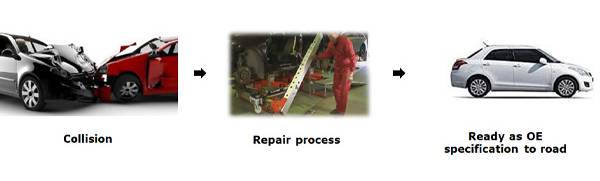
About Collision Repair
What is the advantage of repair?
Replacement costs can be significantly reduced by restoring worn components rather than replacing them. This is
especially the case when the damage or wear is limited in areas(as OEM recommended).
The future of collision repair hinges upon the capacity of industry professionals to innovate and enhance the
quality, integrity, and durability of components. Crash repair experts must also continue in their quest for
innovation to assist customers in economizing while acquiring newer, technologically advanced vehicles. Through
progress and innovation, collision repair professionals will persist in reshaping how consumers perceive the
automotive industry.
Chapter 2: Collision Repair System – Damage Assessment & Inspection
Factors of Damage Assessment
Importance of Crumble Zone
To absorb the impact energy, the distorsion areas are made of integrated zones which can fold in case of
damage called as Crumble Zone
Remember that loading a car into a crash repair system should be done by trained professionals who are familiar with
the specific equipment and safety protocols in the repair shop. Safety is paramount, both for the personnel involved
and for the vehicle being repaired
Begin Repairs :
With the car securely loaded on the repair system, you can now start the necessary repair work, which may
include straightening the frame, replacing damaged parts, and refinishing the vehicle.
Chapter 4: Features & Benefits of Collision Repair System
Features
Lifting Bench : Powered with 10 Ton capacity pneumatically operated hydraulic pump with locking provision
and wheels.
Ramps : Galvanized panels with stands and it is detachable.
Bench : Powder coated MS material and can be detached.
Pulling tower : Made of special aluminum can be fixed all around the bench and from each point it can cover
70 % of the vehicle.
Sill clamps : By tightening single bolt it will hold the car and also itself gets tightened to the bench.
Pulling tower pump : Pneumatically operated, Hydraulic pump of 10 ton capacity.
Benefits
Save time
More rotation of funds
Customer delighted
There is less fatigue
Technician desire
Chapter 5: Collision Repair System – Application
Application
Sideways Pulling
Upward Pulling
Downward Pulling
Autorobot Crash repair system is ready for quick pulls to all directions (sideways, upwards/downwards).
The “pulling process” in the context of a crash repair system typically refers to a part of the repair process where
damaged or misaligned vehicle components, particularly the frame or structural elements, are realigned or “pulled”
back into their proper position. This process is essential in collision repair to ensure that the vehicle’s structural
integrity and alignment are restored to OE specifications.
Assessment : The first step in the pulling process is to thoroughly assess the extent of the damage.
Technicians use various tools and measuring equipment to determine the misalignment and damage to the vehicle’s
frame and structure.
Frame Straightening : If the frame or structural components are damaged or misaligned, the repair
facility will use specialized equipment such as frame racks and hydraulic pulling systems to gently and precisely
apply force to straighten and reshape the damaged areas. This can involve pulling, pushing, and bending the metal to
return it to its original shape.
Mounting and Clamping : The damaged vehicle is securely fixed to the frame rack or pulling system using
specialized clamps and fixtures to prevent any movement during the pulling process. This ensures that the force
applied is directed precisely to the damaged areas.
Pulling and Measuring : Technicians use hydraulic pulling tools and measuring systems to carefully apply
force to specific points on the damaged components. During this process, they continually measure and check the
alignment of the vehicle to ensure it matches the OE specifications.
Verification : Once the pulling process is completed, technicians verify that the vehicle’s structure is
aligned correctly. They use measuring systems and alignment equipment to ensure that the repaired components match
the OE specifications.
The pulling process is a critical step in collision repair, as it helps ensure the structural integrity and safety
of the vehicle. Skilled technicians with specialized training and equipment are typically responsible for performing
this task to restore the vehicle to its original condition.
Chapter 6: Measuring System
Measuring system assists you with chassis and upper body straightening work by telling the direction and extent of
straightening
Why Measuring System?
Measuring tools are crucial in an automotive workshop as parts must meet specific tolerances to ensure proper
functionality and durability under various stresses.
The measuring system in a body shop serves several important purposes:-
Accurate Repair Assessment :
Measuring systems help assess the extent of damage to vehicles involved in accidents or collisions. By precisely
measuring dimensions and alignments, technicians can determine the areas that require repair or replacement.
Alignment Verification :
These systems ensure that repaired or replaced components are aligned correctly with the vehicle’s original
specifications. This is crucial for maintaining structural integrity, safety, and overall performance.
Quality Control :
Measuring systems aid in quality control by verifying that repairs meet original manufacturer specifications(OEM).
This helps ensure that vehicles leaving the bodyshop are safe and adhere OEM dimensions.
Enhanced Efficiency :
Utilizing measuring systems can streamline repair processes by providing technicians with accurate data upfront,
reducing the need for trial and error during repairs. This efficiency can lead to faster turnaround times for
customers.
Customer Satisfaction :
By using precise measuring systems, Bodyshop can deliver high-quality repairs that meets exceed customer
expectations. This can enhance customer satisfaction and reputation, leading to repeat business and positive
referrals.
Overall, the measuring system in a body shop plays a vital role in ensuring accurate, efficient, and high-quality
repairs, ultimately benefiting both the users.
Chapter 7: 3D Measuring System
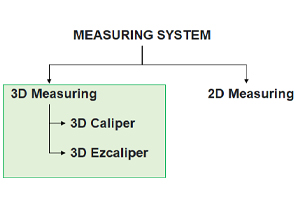
3D Measuring system can measure three surfaces; length, width, and height.
3D Measuring system is an advanced measuring device for exact verification of vehicle chassis and body condition
and for damage documentation.
With Autorobot’ s easy-to-use measuring system car chassis and body measuring is very efficient. Mechanical 3D
measuring system consists of the mechanical device for car chassis and of the measuring arch moving over entire
car body.
AUTOROBOT EZCALIPRE 3D
Chapter 8: 2D Measuring System
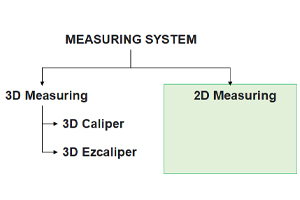
2D Measuring system can measure two surfaces; length and width
Two dimensional or 2D shapes do not have any thickness.
Measuring tram is an advanced 2D measuring device for exact verification of vehicle chassis and body condition and
for damage documentation. The new tram can be used for 2D measuring in all kinds of surroundings.
What is a tram gauge used for?
Tram instruments are essential tools for evaluating collision damage in unibody cars and for verifying critical
measurements during repairs. They are versatile tools used to check dimensions between control points on suspension
and mechanical components.
Conclusion:
In this blog chapters, we had gone through collision repair system & measuring system from Autorobot.
Application and usage with key features makes Autorobot bench unique from others.