
You’re not pricing the wrong clients. But you might be pricing the wrong thing.
MTD for Income Tax didn’t add four submissions. It changed what you’re responsible for.
In rooms full of accountants and bookkeepers, the concern isn’t the software. It’s the conversation.
“How do I charge for this without losing clients?”
Here’s what we’ll cover:
E-Book: MTD for Income Tax—The final countdown playbook for practices
Accountants and bookkeepers still have time to create a repeatable plan for MTD success. This e-Book explains how, via a fast-track mindset, and a 5-phase countdown to April 2026—and beyond.
Get Making Tax Digital: The Final Countdown Playbook
The MTD myth
“It’s just pressing a button.”
Quarterly updates. A submission. A click.
From the outside, that’s all MTD looks like.
So, the price uplift feels tiny.
But what changed isn’t the button—it’s everything behind it.
The visibility gap
Clients see submissions. You carry responsibility.
Clients see:
- A deadline
- A number
- A confirmation
What you actually carry:
- Chasing missing records
- Cleaning incomplete data
- Reviewing inconsistent categorisation
- Ongoing liability
The client sees a submission. You carry the risk if it’s wrong.
Your pricing problem lives inside that gap.
| What clients see | What you carry |
| Submissions | Chasing |
| Buttons | Clean-up |
| Deadlines | Review risk |
| Admin | Ongoing responsibility |
“It takes quite a lot longer to do a bridging submission, because you’ve got to relay all the boxes.”
Rebecca Benneyworth,
Tax consultant and MTD Working Group member, ICAEW MTD Live
The behaviour layer
The real cost driver isn’t submissions. It’s behaviour.
Under MTD for Income Tax, the cost depends on:
- How clean the records are
- How quickly information arrives
- How often corrections are needed
- How engaged the client is
Two clients. Same turnover. Same four updates.
- One sends a tidy spreadsheet.
- One sends 47 untagged transactions and a photo of a shoebox.
Same revenue. Four times the work.
Same fee?
The responsibility shift
The work no longer has a finish line.
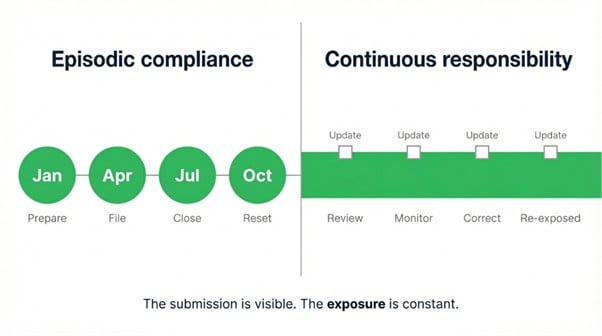
Before MTD, work felt episodic:
Prepare → File → Close → Reset.
Under MTD for Income Tax:
- Records are rarely complete
- Oversight is continuous
- Risk doesn’t disappear at submission
- Handover mid-year is messy
Responsibility doesn’t reset. It rolls forward.
You can’t opt out of the MTD shift. You can only decide whether it’s priced properly.
That’s the structural change.
“That filing is a responsibility. It’s a deadline that we’ve got to work to. If clients don’t deliver, that changes everything.”
Rebecca Benneyworth,
Tax consultant and MTD Working Group member, ICAEW MTD Live
The model underneath the shift
This is a Continuous Responsibility Model: a structural shift from episodic compliance to ongoing exposure shaped by client behaviour.
It’s not a pricing tweak. It’s a different economic unit.
And the economic unit you’re pricing is no longer a submission. It’s exposure.
E-Book: MTD for Income Tax—The final countdown playbook for practices
Accountants and bookkeepers still have time to create a repeatable plan for MTD success. This e-Book explains how, via a fast-track mindset, and a 5-phase countdown to April 2026—and beyond.
Get Making Tax Digital: The Final Countdown Playbook

Why pricing breaks
If you price only the visible layer (“four updates”, “just a button”, “admin uplift”), you miss:
- Behaviour variability
- Continuous review
- Ongoing risk
And that’s how margin leaks—one invisible hour at a time.
When capacity is already tight, those invisible hours could reduce profit. And even crowd out new work.
The decision
If you price submissions, you’re betting on perfect client behaviour.
If you price responsibility, you’re pricing reality.
You can price MTD as:
Or you can price it as:
- Continuous responsibility shaped by client behaviour
Only one protects your margin when behaviour changes.
What this means in practice
MTD won’t break your pricing because you undercharge.
It’ll break because the economic model has changed.
If responsibility is continuous, then pricing must be too
For example:
- Tier pricing based on behavioural quality
- Monthly retainers rather than annual bursts
- Explicit responsibility clauses in engagement letters
- Behaviour-linked pricing reviews
Hannah Miller, director of Chipperfield Accounting, described requiring clients to deliver data within 14 days of quarter end as a condition of monthly billing—making the fee structure a two-way commitment rather than a unilateral charge.
ICAEW MTD Live
This isn’t theoretical. Practices are already pricing using a Continuous Responsibility Model—they just haven’t had a name for it.
Diagnostic questions, client conversation frameworks, and pricing structures that reflect ongoing exposure rather than submission volume are fully developed here.
Subscribe to the Sage Advice newsletter
Join more than 500,000 UK readers and get the best business admin strategies and tactics, as well as actionable advice to help your company thrive, in your inbox every month.
Subscribe now

PakarPBN
A Private Blog Network (PBN) is a collection of websites that are controlled by a single individual or organization and used primarily to build backlinks to a “money site” in order to influence its ranking in search engines such as Google. The core idea behind a PBN is based on the importance of backlinks in Google’s ranking algorithm. Since Google views backlinks as signals of authority and trust, some website owners attempt to artificially create these signals through a controlled network of sites.
In a typical PBN setup, the owner acquires expired or aged domains that already have existing authority, backlinks, and history. These domains are rebuilt with new content and hosted separately, often using different IP addresses, hosting providers, themes, and ownership details to make them appear unrelated. Within the content published on these sites, links are strategically placed that point to the main website the owner wants to rank higher. By doing this, the owner attempts to pass link equity (also known as “link juice”) from the PBN sites to the target website.
The purpose of a PBN is to give the impression that the target website is naturally earning links from multiple independent sources. If done effectively, this can temporarily improve keyword rankings, increase organic visibility, and drive more traffic from search results.

Leave a Reply