Archives 2025

How much does it cost to open a nail or hair salon?


You have a flair for cosmetic creativity and the skills to transform boring into beautiful. You pair that with an entrepreneurial spirit and what’s your next step?

Opening up your own salon and sharing your gift with the world. If that’s in the cards, you’re probably wondering: “how much does it cost to open a beauty salon or barbershop?” Or more specifically, “how much does it cost to open a nail salon franchise?”

Beauty, hair and nail salon startup costs can vary greatly depending on your particular business model and goals.

You’ll likely be looking at startup cost in the ballpark of £20,000 to £50,000, depending on the nature of your business.

But you’ll need to focus in on the specifics if you want to pin down an accurate estimate. The truth is there’s a lot to consider.

That’s why we created this beauty salon startup cost worksheet and companion guide—to help you parse through the details and get started right.

Here’s what we’ll cover:

Breaking down hair, beauty or nail salon startup costs

Before you can break down the costs of starting a salon, you’ll have to decide what type of salon you want to start.

Hair? Tanning? An all-inclusive spa enterprise?

How much it will cost to open a nail salon can differ quite significantly compared to a general beauty salon, or a barbershop.

One-time costs

The initial, one-time costs to open your salon will vary depending on the type of salon you want to launch and how you plan to go about it.

Do you want to rent or own the physical location? How big is your operation going to be?

These are the kinds of questions you’ll need to answer as you proceed.

You can use these parameters to gauge the estimated costs of your particular startup and answer questions like: “how much does it cost to open a hair salon in the city centre?” or “how much does it cost to start a nail business at home?”

Qualifications

You’re not legally required to have a National Vocational Qualification (NVQ) to open a hair salon or provide hairdressing, barbering, or beauty therapy services in the UK, but it is highly recommended.

NVQs are widely recognised in the industry and free for anyone aged 16-18.

If you’re over 18, you can expect to pay anywhere from £500 to £1600 for 1 year NVQ, depending on the subject and where you’re looking to complete the qualification.

Licences and permits

There are no general licencing requirements for hairdressers and barbers. However, you’ll need to register your salon business with HMRC and with Companies House if you’re setting up a limited company.

You might need a premises licence, as well as various other licences for specific beauty treatments you might want to offer. If you plan to play music in your salon or serve alcoholic beverages to clients, you’ll need a PPL Licence and Personal Licence respectively.

The total cost for all these licences, permits, certificates, and registrations can easily add up to around £2,000.

Physical location

Now that you’ve got the admin covered, it’s time to consider your physical space.

If you’re looking to lease, you’ll most likely be responsible for a security deposit and a couple months of rent up front.

Costs will vary depending on location and size. On average, you can expect to pay around £600-£2,000 per month for a mid-range salon and £2,400 or more per month for a prime location or high-end salon.

If you plan to rent a booth in a salon, typical prices range from £250 to £800 per month in smaller towns and suburban areas, or £800 to £1,500+ per month in larger cities and prime urban locations.

If you want to purchase a space, you can expect to pay a deposit of 25%-40% of the property value for most commercial mortgages.

Salon equipment

Equipment costs will vary depending on type of salon. The chairs alone can cost anywhere from £150 to over £1,000 each. Similarly, each washbasin might come to hundreds of pounds.

A full set of new hair salon equipment could cost you from around £5,000 to more than £30,000, depending on how many workstations you need and the quality if the equipment.

If you’re leasing a space, you’ll pay a monthly fee instead, so equipment costs will likely be more limited.

Initial supplies

Both hair and nail salons use specialty products for client services.

Costs will vary by brand but make sure you consider things like hair capes, towels, shampoos, conditioners, clips, brushes, pins, gloves, hairdryers or hot tools, foils, colour, tint bowls, and staff uniforms.

Stocking up on all beauty salon accessories and supplies you need to get started can easily add up to £10,000 or more.

Initial inventory

If you plan to have a retail portion to your salon, you’ll need to stock an initial inventory of beauty products in addition to shop supplies.

This cost is dependent on the size of the retail display portion of your salon and should be adjusted as you move forward in your venture, driven by customer demand.

You may need professional help negotiating your lease, closing the property sale, or just muddling through the necessary licences and permits for your salon.

Expect to pay around £200 per hour for these services.

Point of Sale (POS) systems

You’ll need a POS system to get paid by your customers.

Handheld card readers cost around £20-£200 each, and you’ll pay anywhere from £250 to over £1,000 for a countertop terminal or full till system.

Marketing and advertising

You’ll probably want to invest a bit of money on promoting the launch and grand opening of your business.

This might range from around £2,200 at lower end of the scale, to £50,000 or more if you’re going all out.

Social media can be an excellent free tool to promote your business, showcase your work, and build a customer base. But you should also consider setting up website for your business.

This might cost from around £500 for something very simple, up to £10,000 or more for a sophisticated, mobile-responsive site with appointment booking capabilities.

Building improvements and refurbishment

If you’re taking over an existing salon, there may be little to no renovations necessary.

However, if you’re starting with a blank slate, you’ll have to consider permanent and non-permanent fixtures as well as any design elements necessary to your business model.

The average cost of a commercial refurbishment ranges from £800 to £1,200 per square metre, with an average total spend of around £35,000.

Working capital

This is the money you’ll need to keep your salon in business initially, covering things like wages, gas and electricity, replenishing your stock, and marketing costs.

Try to make sure you have enough set aside to cover at least three months of operating expenses, but ideally six—potentially around £10,000-£20,000.

How much does it cost to run a salon monthly?

When thinking about launching your business, you’ll also need to consider ongoing and recurring costs like your beauty, hair or nail salon’s monthly expenses and bills.

Recurring costs are the consistent expenses you’ll be seeing as your business grows. These are your day-to-day, month-to-month, and year-to-year costs of normal business operations.

You can’t avoid them so make sure you think about how to manage your expenses on an ongoing basis. To keep your costs as low as possible, consider using tools such as free accounting software.

Mortgage or lease payments

Whether you rent or buy, you’ll have a monthly payment to keep the doors open. Costs will vary greatly, but make sure to factor them into the budget.

Salon insurance cost

The average salon insurance cost can range from £500 to £1,500 for basic coverage, with more comprehensive policies costing around £2,000.

In addition to contents insurance, you’ll want to consider public liability insurance, employers’ liability insurance, and professional indemnity insurance.

In fact, if you plan to hire any members of staff, public liability insurance and employers’ liability insurance are both legal requirements.

Licences and permits

Some of the licences and permits you need may involve annual or other recurring charged.

Salaries

Depending on your business model, you may be paying a salary to each of your stylists. You could very well operate on a commission-based model.

This cost will range according to your employee payment structure. Also keep in mind that you, the owner, should be taking a salary too.

Cleaning

Cleanliness is key for health compliance as well as your general business image.

Stay on top of regular housekeeping and make sure to account for mops, vacuums, toilet paper, bleach, general purpose wipes, and access to laundry services.

The average cost of professional, commercial cleaning service in the UK is £22 per hour, although you and your staff will still be responsible for the day-to-day upkeep.

Equipment lease payments

If you choose to go the route of leasing your salon equipment, factor these monthly costs into your budget. They will vary depending on your particular lease agreement.

Utilities

Electricity, gas and other utility bills will vary by the kind of equipment your salon uses, as well as the size and location of your business.

But the average costs of business energy bills range from £2,715 to £13,438 for electricity and from £914 to £5,267 for gas.

POS software

In addition to your till and POS hardware, you’ll want to consider POS and payment management software.

There are basic pay-as-you-go apps you can use for free, or you can invest in a more sophisticated solutions, ranging from around £20 to £200+ per month.

Credit card processing fees

Here’s a potentially sneaky expense.

As a modern business, you’ll want to accept credit card payments. Standard business rates for processing fees range from 1.5% to 3.5% of the sale value, on top costs like monthly fees and card machine rentals.

Marketing

You’ll need to get the word out about your business on a continuous basis.

There are a number of avenues you can take (print, broadcast, web, social advertising), some of which are free, but most businesses spend 2-5% of their revenue on marketing.

Contingency budget

You never know what issues may arise. To stay prepared, budget in some contingency money to cover unforeseen, miscellaneous expenses.

Aim for a contingency fund of around 10-15% of your total budget.

Common salon startup myths & mistakes

How much it will cost to open a beauty, hair or nail salon is one of the first and most fundamental questions you need to answer.

But there’s a lot more to think about when starting a salon or barbershop.

Aside from the specific expenses and hurdles of your chosen salon type, there are some general considerations every new business owner should have on their radar.

  1. Don’t fear technology. Modern businesses need to take full advantage of today’s computer resources. That means collecting every bit of customer data you can. Does your customer only come in for nail services, or do they take advantage of the spa, nail and hair services you offer? Make note of that! Every transaction should be entered into your digital filing system with details. That data can be used strategically in developing best business practices and for targeted advertising down the line.
  2. Don’t pass on quality products. You cannot forgo quality in a professional salon. The products you use will reflect on your quality of service. Some salon owners try to save money by using inexpensive alternatives but end up paying in the long run. Clients come to you for an experience they don’t get at home. It’s simple—better products make for a better experience.
  3. Don’t skimp on cleanliness. We talked about this earlier, but we can’t stress it enough—the salon environment should be the epitome of clean. You want your salon to serve as a getaway, a little slice of paradise for your customers. Keep a fresh, neat shop and the clientele will keep coming back.
  4. Don’t forget continuing education. Even the most advanced skills can be sharpened. Every stylist working at your salon should go through the same training. You want a skilled staff that is up-to-speed on the latest trends to best serve the brand and style of your salon. Making sure all staff are properly trained on new techniques and styles—keeping their skill set fresh and sharp—keeps clients excited. Moreover, continued education keeps you competitive with other salons, and clients know they will always receive quality service when they walk through the door.
  5. Don’t try to please everyone. The truth is you’re not going to attract everyone. So, transform that into a positive. Maintain a pointed aesthetic and perfect it. Devote your efforts to making your salon an authority. Become the expert to best satisfy your target demographic and your ideal client base will find you.

Beauty, hair and nail salon startup costs: Industry tip

Running a salon is hard work. Don’t get bogged down tracking expenses—consider upgrading to online accounting software with Sage Accounting to save time and money.

How to use the salon startup cost worksheet

Our beauty, hair and nail salon startup cost spreadsheets are simple and intuitive to use. Once downloaded, they’re fully customisable to fit your needs.

  1. Download the free salon expenses spreadsheet template.
  2. Add or remove fields applicable to your startup.
  3. Assess your needs and related costs.
  4. Make a note of costs that might change or costs to be determined.
  5. Plug in your numbers and enjoy the simplified breakdown of your startup and ongoing costs.

Sage lets you focus on building your business, not tracking expenses

Opening and maintaining a salon requires a lot. Day in and day out you invest your time, energy and focus into creating something amazing.

So why waste your valuable time and efforts tracking expenses the old-fashioned way?

Administrative tasks can now be fully automated—so upgrade your business model with Sage Accounting.

You have enough on your plate and our online accounting software can save you time and money. Outsource the busy work and get back to doing what you do best—making your business a success.

Additional startup cost templates

Is our sample salon startup cost calculator not what you’re looking for? Then, please check out our other templates. We also offer solutions for all of your startup needs.

Important information about these salon and barbershop startup costs

The startup costs shown here by industry are merely guidelines and average estimates based on information pulled from a variety of sources. While we have attempted to present the most accurate information available, please be aware that startup costs can vary greatly according to a number of factors, including but not limited to your location, local fees, and contractor quotes. The information presented here is intended to help guide prospective business owners in the search for information on starting a business within a given industry, but should not be interpreted as an exact quote.

Sage provides the information contained here as a service to the public and is not responsible for, and expressly disclaims all liability for damages of any kind arising out of use of, reference to, or reliance on any information contained on this site. While the information contained on this site is periodically updated, no guarantee is given that the information provided is correct, complete, and up-to-date. Sage is not responsible for the accuracy or content of information contained on this site.


Automotive

Agen Togel Terpercaya

Bandar Togel

Sabung Ayam Online

Berita Terkini

Artikel Terbaru

Berita Terbaru

Penerbangan

Berita Politik

Berita Politik

Software

Software Download

Download Aplikasi

Berita Terkini

News

Jasa PBN

Jasa Artikel

Costs for starting a food truck business


Food trucks are growing in popularity, and it’s not hard to understand why.

The fact that they’re significantly cheaper to launch than a brick and mortar restaurant, with more freedom to create your own unique business model, is enticing both newcomers and seasoned restaurateurs.

But how much does it cost to start a food truck business? As you might imagine, that depends on a number of factors, but the average cost of starting a food truck can range from around £5,000 to £50,000.

Use our free worksheet to break down how much it might cost to start a food truck, based on your circumstances.

Here’s what we’ll cover:

Breaking down food truck startup costs

The average food truck startup costs can vary dramatically depending on how big you want your operation to be, the location you wish to serve, and a range of smaller choices you’ll need to make.

And of course, there’s the actual truck—are you going to rent or own? There are benefits to both, but keep in mind that buying a quality truck outright can be expensive.

When working out the fixed and variable costs to start a food truck, it can be useful to break down one-time costs as well as ongoing food truck expenses, to get a clear picture of both the initial and ongoing investments needed.

One-time food truck expenses and costs

Understanding how much money you’ll need to start a food truck includes having a realistic view of the initial one-time costs it’ll take to get your business up and running.

When considering these capital investments, bear in mind that you won’t be making a profit right away, so you’ll need to have a cushion of money in the bank to sustain your business as it gets rolling.

We’ve outlined some initial average startup cost for a food truck below, that you’ll want to consider.

Permits and licencing fees

You’ll need a business licence or certificate, which can range from around £100 to £500 or more depending on your location, as well as a street trading licence, which can cost hundreds of pounds.

To get a food premises approval, you might have to organise a visit from the Food Standards Agency, which costs £395.40.

You might also need various other licences and permits, including a health permit, a fire permit, and an alcohol licence (if you plan to sell alcohol).

Check with your local council to find out exactly which permits and licences you’ll need and how much they will cost you.

The truck

For those who opt to buy their truck rather than rent, this may be the biggest initial expenditure you make.

Expect to pay anywhere from £5,000 to £50,000 for a new food truck, complete with fittings and equipment, while second-hand options start from around £1,000.

Research your food truck and find out what’s included if you’re planning to buy it.

The costs you allot for the truck should include the truck itself, a custom paint job (if needed), as well as the kitchen and serving equipment (if it’s not included with the truck).

Although second-hand and other more affordable trucks can minimise your initial spend, it’s worth considering a newer truck if you can afford it.

Cutting corners when purchasing the truck could be a false economy if you end up forking out a small fortune on costly repairs, like replacing the engine, transmission, tires, etc.

Initial food and drink inventory

You’re going to have to stock up for your grand opening—and beyond.

The cost of your inventory will depend on what you’re planning to serve, but it’s a good idea to budget for several weeks’ worth of supplies to begin with.

Expect to set aside on average £1,000-£5,000 to cover a startup supply of food, drink, packaging, and other disposable supplies like plates, bowls, napkins, cups, cutlery, etc.

Register/Point of Sale (POS) solutions

Of course, you’ll need a way to get paid and keep track of those payments.

Handheld card readers are typically £20-£200 each, while a countertop terminal or full till system might cost you from around £250 to over £1,000.

To save some money at the start, you can use a tablet with a credit card reader, rather than springing for a more intricate system.

Equipment

Some of the essential equipment you’ll need for your mobile kitchen might come with the food truck, including pots, pans, cooking appliances, fridge, storage, counters, and a generator.

But if not, you’ll have to purchase this yourself.

On average, you can expect to spend around £5,000 to £20,000 on equipment.

Uniforms/t-shirts

This one is optional and depends on how many employees you’ll have, but it’s a good idea to have some degree of uniformity if you want to look professional.

You can wear your own clothes for £0, spend a couple of hundred pounds on branded t-shirts and aprons, or splash out for something more elaborate, budget allowing.

Fire extinguisher

Grease fires can happen in a food truck, and you don’t want to see your investment go up in smoke. Additionally, permits may expect you to have a fire extinguisher in your truck.

Look for a fire extinguisher designed to fight most types of small household and kitchen fires (grease, electrical, etc.), with costs starting from as little as around £20.

Contingency and miscellaneous expenses

You never know what issues might crop up as you build your business, so it’s good to have some buffer money set aside.

Your contingency budget will depend a bit on the size your operations, but typically it would range from around £5,000 to £60,000.

It’s a good idea to have enough to cover at least a few months of running costs.

Food truck monthly expenses and recurring costs

As your food truck develops, you’re going to have some daily, monthly and annual costs to take care of—and these have a pretty big range depending on the type of truck.

No matter what, it’s always a good idea to shop around for the best rates, so make sure you do your research when budgeting for your longer term food truck startup costs.

Commissary fees

If you need to rent a commercial kitchen space to prepare your food in, this can easily cost from around £400 to £1,500 per month.

Food truck insurance costs

Catering insurance for food trucks can cover things like public liability, employers’ liability, business equipment, stock, personal injury, and legal expenses.

The average catering insurance for a sole trader with a mobile van starts from around £68 per year.

However, you may need more comprehensive cover and even quotes at the lower end of the scale will vary widely depending on your specific business circumstances.

You’ll also need commercial vehicle insurance, which can cost from around £500 per year, and it’s worth considering breakdown cover if this isn’t included with your commercial vehicle cover.

Some specialised insurers can offer policies designed for food trucks and catering vans, combining commercial vehicle and catering insurance with breakdown cover.

Food, beverages, and disposable supplies

You’ll be paying out regularly to replenish your supply of food, drink, packaging, and other food-related disposable supplies.

Cost depends on what you’re selling and how much of it.

But typically these costs might sit at around £2,000-£15,000 per month or 30-35% of your food sales, including topping up on supplies like plates, cups, bowls, cutlery, napkins, etc.

Fuel and maintenance

Depending on how far you travel and how long you stay open, you can expect to spend about £200-£500 per month on fuel and maintenance.

Social marketing

Social media is your friends. This one is a rare freebie on the cost sheet, so take advantage of it and build your following.

Website

Social media can only take you so far. A professional website will set you apart from competitors.

Expect to pay at least £500 for something very simple, and up to £10,000 or more for a sophisticated, mobile-responsive site—plus domain costs to maintain it.

POS software

When it comes to POS and payment software, there are basic pay-as-you-go apps you can use for free—or you can invest in a more sophisticated solutions, ranging from around £20 to £200+ per month.

Business Wi-Fi / internet

You could consider a pay-as-you-go data SIM with a mobile hotspot (MiFi) for around £65-£95, or a 4G-5G router with a data plan, potentially costing from £30 upwards.

Staff salaries

This one really depends on your particular set-up. If it’s just you and a partner doing all the work, cross it off the list—you’re both taking it for the team.

If you have employees, you are legally obliged to pay at least the National Minimum Wage hourly rate for apprentices and anyone aged under 21, and the National Living Wage hourly rate for anyone who’s 21 or over.

Common food truck startup myths & mistakes

There’s a lot of information floating around about opening up a food truck and the average startup costs involved.

Unfortunately, that means there’s also a lot of misinformation. So, we’ve decided to take some of the most commonly discussed food truck startup myths and mistakes and give you the real scoop.

  1. Mind the licencing and permitting process. Bottom line: all your business-related licences and permits must be current and up-to-date. Make sure you do your research and find out the exact requirements for operating in your area of choice. Contact the council(s) you plan to do business in and make sure you have all the right licences and permits, or risk hefty fines and potential closure.
  2. Find the right events. And make sure you’ll have a spot when you get there! New food truckers might not realise that there are usually waiting lists for popular events—and they can stretch up to years in advance. Get in touch with the organisers to secure your spot. And don’t forget to find out the associated fees.
  3. Don’t skimp on the truck. Too often, food truck owners starting out try to cut corners, but it you’re not smart about your choices, it can end up costing you dearly. Our advice: spend as much as you can realistically afford on your truck. Mechanical problems down the line can end up costing a lot more than buying a truck that’s in good condition to start with.
  4. Take advantage of social media. Not many things come free in this world, so make sure you take advantage of these free marketing channels. It’s easy to overlook the power of social media when you’re busy running your truck, but it can play an important role in building your business. Giving you the ability to connect with potential customers, offer specials, and announce where you’ll be next, social media is key to generating buzz around your truck.

Food truck startup costs: Industry tip

Running a business is hard work, so don’t get bogged down tracking your food truck expenses. Use free accounting software to simplify your financial admin and minimise costs.

Or, consider upgrading to affordable accounting software for small to medium businesses with Sage Accounting.

How to use the food truck startup cost worksheet

Our food truck startup cost spreadsheets are easy and intuitive to use. Once downloaded, they’re fully customizable to fit your needs.

  • Download the free food truck budget template.
  • Add or remove fields applicable to your startup.
  • Assess your needs and related costs.
  • Make a note of costs that might change or costs to be determined.
  • Plug in your numbers and enjoy the simplified breakdown of your startup and ongoing costs.

Sage lets you focus on building your business, not tracking expenses

Working out how much it will cost to start a food truck is only the first step. Opening and maintaining your food truck business takes a lot.

Day in and day out you invest your time, energy and focus into creating something great. So why waste your valuable time and efforts tracking expenses the old-fashioned way?

Administrative tasks can now be fully automated—so upgrade your business model with Sage Accounting.

You have enough on your plate and our online accounting software can save you time and money. Outsource the busy work and get back to doing what you do best—making your business a success.

Additional startup cost templates

Is our sample food truck startup cost calculator not what you’re looking for? Please check out our other templates. We also offer solutions for all of your startup needs.

Important information about these food truck start up costs

The startup costs shown here by industry are merely guidelines and average estimates based on information pulled from a variety of sources. While we have attempted to present the most accurate information available, please be aware that startup costs can vary greatly according to a number of factors, including but not limited to your location, local fees, and contractor quotes. The information presented here is intended to help guide prospective business owners in the search for information on starting a business within a given industry, but should not be interpreted as an exact quote.

Sage provides the information contained here as a service to the public and is not responsible for, and expressly disclaims all liability for damages of any kind arising out of use of, reference to, or reliance on any information contained on this site. While the information contained on this site is periodically updated, no guarantee is given that the information provided is correct, complete, and up-to-date. Sage is not responsible for the accuracy or content of information contained on this site.


Automotive

Agen Togel Terpercaya

Bandar Togel

Sabung Ayam Online

Berita Terkini

Artikel Terbaru

Berita Terbaru

Penerbangan

Berita Politik

Berita Politik

Software

Software Download

Download Aplikasi

Berita Terkini

News

Jasa PBN

Jasa Artikel

Margin calculator (how to calculate profit margin)


How much of your business’s selling price do you retain as profit? If you raised prices or cut costs, how would these adjustments affect your margin?

And do you know how your margin compares to your markup?

Whether you’ve been in business for years or you’re setting your first pricing strategy, you need to know how to calculate profit margin.

While the formula is straightforward, margin has many nuances.

For your reference, we provide a margin calculator that can do the math for you, or help you to check your own calculations when figuring out your pricing and costs.

In this article, we’ll also cover the essentials of margin, including the differences between gross and net margin, and how margin relates to markup, so you can analyse productivity more effectively.

By the end, you’ll understand how to calculate gross margin so you can confidently set prices that cover production costs while providing the profit your business needs to succeed.

Note that this article talks about gross margin unless otherwise stated.

Here’s what we’ll cover

Margin calculator

You can use this gross margin calculator to evaluate your own business or the competition.

Here are a few ways to use this tool:

  • Determine profit margin across the business or for a specific product or service.
  • Set new prices for your products or services.
  • Calculate what a product or service should cost to stay competitive while maintaining a certain margin.
  • Analyse competitors’ profit margins based on your knowledge of their selling price and cost price.

To calculate margin, input selling price and cost price.

Press “calculate” to see the margin expressed as a percentage.

Toggle through the buttons at the top to calculate selling price or cost price instead.

What is margin?

Margin represents profit as a percentage of an item’s selling price.

Also known as gross margin, it reflects the percentage of the selling price that remains after accounting for the cost of the item (i.e., labour and materials).

It’s the ‘margin’ of difference between the price it costs to make an item and the price it’s sold for.

You calculate margin by subtracting the cost of goods sold (COGS) from the selling price.

Then, you divide the result by the selling price and multiply by 100 to get the profit percentage.

Margin formula

Margin = ((Selling Price – Cost Price) / Selling Price) x 100

For example, suppose you sell a product for £100. If it costs £60 to produce, your margin would be:

Margin = ((100 – 60 )/ 100) × 100 = 40%

This means 40% of the selling price is profit, while 60% represents the production cost.


How to calculate selling price using margin

Do you want to know how to set the selling price to achieve a certain profit margin? This can be useful when you know the industry standard margin and want to set your prices accordingly.

If you know the margin and the cost, you can easily calculate the selling price. Rework the gross margin calculation above into this formula:

Selling Price = Cost / (1 – Margin)

For example, suppose your goal is a margin of 25%, if the item costs you £150 to produce, your selling price should be:

Selling Price = 150 / (1 – 0.25) = £200

How to calculate cost price from selling price and margin

Do you need to know how much your COGS should be so you can reach a certain margin?

This can be useful when doing competitor research and helps you to remain competitive in the market.

With this formula, you can quickly determine your cost price:

Cost Price = (1 – Margin) x Selling Price

For example, suppose your selling price is £500, if you want your margin to be 30%, your cost price should be:

Cost Price = (1 – 0.3) x 500 = £350

What’s the difference between gross profit margin and net profit margin?

This article has been discussing ‘gross margin’, but you might also encounter the term ‘net profit margin’ and get confused or think they are the same thing.

These metrics are different and it’s important not to get them mixed up.

It’s also very important to use the right terminology when talking to your customers or suppliers.

Gross profit margin accounts for COGS only, which reflects direct costs.

However, this metric can only tell you so much about your company’s profitability.

Net profit margin also accounts for indirect costs, which reflect business expenses.

This metric factors in direct costs like labour and materials plus indirect costs like taxes, interest, and operating expenses.

Let’s compare the two metrics side by side.

Gross profit margin Net profit margin
Gross profit expressed as a percentage of the selling price. Net profit expressed as a percentage of turnover.
Factors in COGS only. Factors in COGS and expenses.
Gross profit margin =
((Selling price − Cost price) / Selling price × 100
Net profit margin =
((Turnover – COGS – Operating expenses – Interest – Taxes) / Turnover) x 100
If the selling price is £100 and the cost price is £25, the gross profit margin is 75%. If a company has quarterly turnover of £100,000 with COGS of £25,000 and expenses of £25,000, the net profit margin is 50%.
Helps you understand how production costs affect your profit margin. Helps you understand your organisation’s financial health and assess profitability.
Doesn’t show how overhead costs or business expenses affect your margin. Doesn’t offer insight into production costs and may show skewed results based on one-time transactions.

Should I use gross profit or net profit?

Both profit margin metrics help you understand your profit percentage.

But, because they use distinct inputs and reveal different insights, each has specific use cases.

When to use gross profit margin

Use gross profit margin when you need to know how production costs affect your margin.

A gross profit margin calculator can tell you how much you should reduce COGS to increase your margin to a certain level.

This metric is also helpful for setting your pricing strategy.

Gross profit margin tells you how to price an item to achieve a certain profit percentage.

When to use net profit margin

Use net profit margin when you need a more complete look at your company’s financial health.

With this metric, you can monitor profit-related trends and forecast profits for future time periods.

Typically, you have to share your net profit margin when applying for funding.

It’s one of several figures finance providers use to determine profitability and assess cash flow.

What is the difference between margin and markup?

It’s also essential to know the difference between two other metrics.

It’s easy to confuse margin and markup as they are used interchangeably in trade and industry, but if you get these mixed up, you could cause real problems in your pricing strategy and make a loss.

Margin and markup both use the same inputs (selling price and cost price) as a way to analyse profitability. However, the calculations and insights are completely different.

To set appropriate pricing and stay profitable, you have to understand how margin and markup differ. Let’s compare them side by side.

Margin Markup
The percentage of the selling price that is profit. The percentage added to the cost price to arrive at the selling price.
Margin =
((Selling Price – Cost Price) / Selling Price) × 100
Markup =
((Selling Price – Cost Price) / Cost Price) × 100
Calculated based on the selling price. Calculated based on the cost price.
If a product costs £60 and sells for £100, the margin is 40%. If a product costs £60 and sells for £100, the markup is 66.67%.
Helps understand the profitability of sales. Helps determine the selling price needed to achieve desired profits.

Markup vs. margin calculation example

Suppose you own a flower shop and you want to set the selling price for a custom bouquet.

You know the cost to create the bouquet is £10 and a markup of 60% would give you a competitive advantage.

You can calculate selling price using this markup formula:

Selling Price = £10 + (£10 x 60%) = £16

Here’s another way to calculate selling price based on markup:

  • Your cost price = £10
  • You want a markup of 60% = £6
  • Add the markup to the cost price to determine the selling price = £16

Now suppose you want a 60% margin. Here’s how to calculate selling price based on margin:

Selling Price = £10 / (1 – 0.6) = £25

A 60% margin on a bouquet costing £10 would require a selling price of £25.

A 60% margin results in a higher selling price (£25) compared to a 60% markup on the same bouquet (£16).

As you can see, understanding the difference between margin and markup is essential for setting a selling price that aligns with your goals.


When should I use margin and when should I use markup?

Markup uses cost as a base input. It’s most useful for setting initial selling prices.

Consider markup when calculating how much to increase the selling price from the cost price.

Use it to ensure you price items competitively in your industry or region.

Margin is based on selling price or turnover.

It’s useful for calculating short- and long-term profitability.

Consider margin when you need to calculate profitability for a certain item or for the business as a whole. It also factors into financial reporting since it plays a role in profit and loss statements.

What do I need to consider when I calculate margin?

When determining margin, keep these factors in mind:

1. Selling price

Confirm the market will support the selling price.

Competitor pricing and customer perception are 2 factors that affect whether customers will pay the price.

2. COGS

Economic conditions and market trends may change the cost of labour or materials over time. Monitor your COGS so you can take action if necessary.

For example, if your COGS increases, you would need to either reduce your costs, or increase your selling price to maintain the same margin.

3. Growth stage

The age or growth stage of the business may affect the margin.

For example, new businesses often experience lower profit margins than established companies.

In the early days, businesses tend to have fewer customers and limited opportunities to earn revenue.

Over time, they move towards operating more efficiently, leading to a higher profit margin.

4. Industry standards

Profit margins aren’t consistent from industry to industry.

To determine whether your margin is good or sustainable, review industry-specific data.

The importance of margin and how it’s used in business

Margin provides many important business insights.

Calculate this metric to:

  • Set or revisit your pricing strategy: Use the margin formula to calculate your margin at various price points.
  • Decide when to cut costs: If your margin decreases, you can determine how much to cut expenses or labour costs.
  • Analyse profitability of units or time periods: Use the margin formula to measure profit percentage for either individual items or the entire business during a specific timeframe.
  • Measure your company’s financial health: A positive margin confirms you’re generating a profit, while a negative margin indicates your costs are higher than your turnover.
  • Assess operational efficiency: A higher margin reflects greater efficiency and a higher ratio of revenue to cost.


FAQs

Gross margin vs. gross profit vs. operating profit

Gross margin, gross profit, and operating profit are all business terms that refer to profitability.

However, each one reveals different information and applies to specific contexts.

Gross Margin Gross Profit Operating Profit
Percentage Pound sterling amount Pound sterling amount
Profit as a percentage of selling price Profit after accounting for COGS Profit after accounting for operating expenses, COGS, depreciation, and amortisation
Gross Margin = ((Selling Price – Cost Price) / Selling Price) x 100 Gross Profit =
Turnover – COGS
Operating Profit =
Turnover – COGS – Operating Expenses – (Depreciation + Amortisation)
Applies to specific products and services or to the entire business Applies to specific products and services or to the entire business Applies to core business operations
Helpful for setting prices and assessing profitability over time Helpful for measuring profitability without overhead or fixed expenses Helpful for calculating earnings before interest and tax (EBIT)

What is a good margin?

According to UK industry data from the Office for National Statistics (ONS), average gross margins vary significantly by sector. For example, retail margins typically range between 20% and 50%, while professional services may exceed 60%.

The definition of a good profit margin depends on factors like the industry, the company, and your own business strategy.

Do you want to pitch at an economy volume market selling a lot of products cheaply?

Or, are you a luxury goods business aiming for a high margin to cover the time invested into making every item and the limited accessible market?

If you are in a new industry or trialling new products, the sweet spot for margin would be between items selling too fast (because they are too cheap, or lack of competition) and selling too slow (too expensive or a saturated market).

You would have to test to find your balance between demand for product and availability of other products.

How do I calculate markup from margin?

You can convert margin into markup with this formula:

Markup = Margin / (1 – Margin) x 100

For example, suppose your margin is 60%. Your markup would be 150%:

Markup = 0.6 / (1 – 0.6) x 100 = 150%


Once you understand how to calculate margin and how it differs from markup, you can easily make choices about pricing your products.

Use our margin calculator to run the numbers for you, or use it to check your own calculations and give you confidence in your numbers.

For help with your financial planning, we offer a cloud-based accounting and business management solution that makes it easier for you to make informed decisions for growth.


Automotive

Agen Togel Terpercaya

Bandar Togel

Sabung Ayam Online

Berita Terkini

Artikel Terbaru

Berita Terbaru

Penerbangan

Berita Politik

Berita Politik

Software

Software Download

Download Aplikasi

Berita Terkini

News

Jasa PBN

Jasa Artikel
Return On Investment (ROI) calculator (Sales & Investment option)


Whether you’re evaluating a potential purchase or analysing an existing asset, you need to know how to measure the return on investment (ROI).

Are you considering an investment but need confirmation that the gains outweigh the costs by a certain ratio?

Have your business partners requested profitability insights prior to making a major acquisition?

In this article, we’ll cover the essentials of ROI, including how to calculate it and maximise it.

We’ll also provide an ROI calculator that can do the math for you or validate your numbers.

By the end of this article, you’ll know how to calculate ROI for use cases ranging from investments to marketing.

You’ll also understand both the limitations of ROI and common calculation mistakes.

Here’s what we’ll cover:

ROI calculator

This calculator works in 2 different ways.

It can:

  1. Calculate ROI based on the amount invested and the amount returned over time
  2. Calculate investment return and growth over a period of time

To calculate ROI, select the “Investment ROI” option. Input the amount invested and the amount returned (actual or projected).

Then, enter either the start and end dates, or the total years of investment.

Press “Calculate” to see the total gain, investment ROI, and annualised ROI.

We’ll explain these metrics in depth below.

To calculate investment growth, select the “Growth calculator” option.

Input the amount invested and the ongoing contributions (including the frequency).

Then, enter the years of growth and the interest rate.

Press “Calculate” to see the total contribution, total interest, investment worth, and investment ROI.

You’ll also see a chart that breaks down the contributions and balance for the investment by year.

What is ROI?

Return on investment, or ROI, is a metric that measures the performance of an investment by comparing the gain from the investment to its initial cost.

ROI is typically expressed as a percentage.

ROI serves 2 main purposes:

Measures the return from investments or acquisitions, which helps you to clarify past performance for reporting purposes.

You can also use ROI to evaluate the gain or loss from past investments or endeavours.

Estimates potential returns, which helps you to gauge profitability. However, ROI is not a forecasting model. For forecasts, more advanced financial models such as discounted cash flow (DCF), internal rate of return (IRR), or net present value (NPV) are typically used.

For example, when acquiring a new company or if you want to purchase assets for your business, such as machinery.

ROI is used widely in business to track performance in reporting and making decisions.

When used for marketing, ROI is a useful tool for you to review where budgets are best allocated and to see if specific campaigns have added value to the business.

Although, as with any measurement, it is important to measure campaigns in isolation to avoid influence from other factors that might show a false picture.

Return on investment is an easy-to-understand metric that offers a simple overview of performance and is universally understood in business.

However, it does have limitations and can be misleading if it’s not presented or provided with context.

Note that it is possible for investments to generate a positive or negative ROI:

  • A positive ROI means the return exceeds the cost
  • A negative ROI means the cost exceeds the return

How do you calculate ROI?

The quickest way to calculate ROI is to use our calculator above.

To do your own manual calculations, you can also use the ROI calculation formulas below.

To learn to calculate ROI manually, try running your own calculations with the formulas and then check them against the calculator.

Standard ROI formula

ROI = ((Value of Investment – Cost of Investment) / Cost of Investment) x 100%

For example, suppose you invest £100,000 and end up with a return of £150,000.

Your ROI would be:

ROI = ((£150,000 – £100,000) / £100,000 x 100% = 50%

The basic ROI formula above doesn’t account for the investment’s time frame.

To factor in the holding time, use the annualised ROI formula below instead.

Annualised ROI formula

Annualised ROI = ((1 + ROI) ^ (1 / n) – 1) × 100%

n =number of years the investment is held

For example, suppose you achieved 50% ROI over the course of 2 years.

Your annualised ROI would be:

Annualised ROI = ((1 + 0.5) ^ (1 / 2) – 1) × 100% = 22.5%

ROI calculation examples

Let’s walk through some examples.

Calculating ROI for marketing

Suppose you managed a marketing campaign with an initial cost of £5,000.

And the campaign generated a return of £25,000. The ROI would be:

ROI = ((£25,000 – £5,000) / £5,000) x 100% = 400%

Calculating ROI for business investment

Say your company is considering a business investment priced at £500,000.

And you’ve projected a future valuation of £2 million. The ROI would be:

ROI = ((£2,000,000 – £500,000) / £500,000) x 100% = 300%

If the valuation is projected for 10 years from now, the annualised ROI would be:

Annualised ROI = ((1 + 3) ^ (1 / 10) – 1) × 100% = 14.9%

Calculating ROI for real estate

Now, suppose your company invested in real estate at an up-front cost of £25,000.

And the real estate ultimately generated a return of £10,000.

The ROI would be:

ROI = ((£10,000 – £25,000) / £25,000) x 100% = -60%

Because the cost exceeds the return, the ROI is negative.

If the investment period lasted 5 years, the annualised ROI would be:

Annualised ROI = ((1 -0.6) ^ (1 / 5) – 1) × 100% = -16.7%

What is the difference between ROI and annualised ROI?

For a standard ROI that is measured between a start and an outcome, the time frame is not a factor that affects the result.

Even over a year or a decade, the ROI remains the same so long as neither the cost nor the gain changes.

A basic ROI would be used to measure investment in a marketing campaign, or the purchase of an asset.

For an annualised ROI, the holding period of the investment is accounted for in the calculation and factors in compounding, which incorporates how an asset generates additional earnings either from capital gains, or from interest over time, or from both.

As you can see in the examples above, longer holding periods lead to bigger differences between ROI and annualised ROI.

Annualised ROI reflects an investment’s annual performance, but it can also be calculated in quarters, halves, and other time frames by turning the holding period into fractions of a year.

Annualised ROI is best used for investments with returns that are either less predictable or that have variable interest rates.

For example, you can use it when evaluating stocks or funds.

This metric is also helpful for comparing the performance of multiple investments. Since it factors in compound interest, annualised ROI simplifies the process of comparing investments with different holding periods.

Limitations of ROI

Despite being a widely used metric, ROI does have some limitations that need to be considered:

Doesn’t account for the holding period

The standard ROI calculation doesn’t reflect the time period for the investment, which may result in an overly simplistic metric.

To assess how the holding period affects the efficiency of the investment, use annualised ROI.

Doesn’t include all relevant costs

Some investments continue to generate additional costs over time.

For example, real estate investments typically incur property taxes, mortgage insurance, and maintenance costs.

If you don’t factor these costs into the calculation, you’ll end up with an inaccurate ROI.

This can provide a skewed assessment of the investment, which may lead to uninformed decisions.

Doesn’t factor in contributions

Many investments have a one-time initial cost.

However, others have monthly, quarterly, or annual contributions.

The standard ROI formula doesn’t account for ongoing contributions.

To calculate ROI for an investment with ongoing contributions, use our growth calculator above.

It reveals investment ROI, investment worth, and balance over time.

Mistakes when calculating ROI

ROI is one of the simplest and most straightforward metrics for measuring profitability.

However, it’s important to avoid common mistakes when calculating ROI:

Neglecting to estimate costs accurately

Without a complete list of the cost of the investment, acquisition, or business initiative, you won’t be able to estimate ROI accurately.

Before calculating ROI, make sure to consider hidden costs like maintenance or licensing.

Measuring the wrong outcomes

This mistake is a particular concern for marketing campaigns.

When calculating ROI, always measure the metrics that contribute to the company’s bottom line.

Rather than factoring in engagement, for example, measure revenue.

Failing to consider risk

Every investment carries some level of risk, from the value of the investment to the timeline for the acquisition.

To ensure you can absorb the probable risk level, calculate ROI based on various likely outcomes.

Forgetting to weigh non-monetary benefits

ROI measures profitability.

However, almost every investment also brings non-monetary benefits that can change the math completely.

Consider factors like corporate reputation or employee satisfaction when reviewing outcomes.

Confusing profit with cash

While investments are cash, ROI doesn’t reflect a cash outcome.

Instead, it indicates profit.

To get a more complete financial picture of an investment, consider the cash flow rather than the profit.

Not measuring ROI over time

It’s crucial to measure ROI before pursuing an investment. But that shouldn’t be the only time you consider this metric.

Instead, continue to measure the actual ROI of existing investments so you can make informed decisions about future investments.

How to maximise your ROI

You can maximise return on investment by taking these actions:

Consider a riskier investment

Generally, the higher the risk level, the higher the ROI.

To maximise ROI, consider increasing your exposure to risk.

Contribute more frequently

Investments like stocks and bonds allow additional contributions over time.

To maximise ROI, contribute increased amounts more frequently.

Increase the holding period

Over time, compound interest can increase the worth of investments significantly.

To maximise ROI, consider longer-term investments.

What is an average or good ROI?

Each type of investment has its own average ROI.

Here are some benchmarks to consider as you evaluate investment performance:

Real Estate

Real estate can be subject to ups and downs on a short-term basis and can deliver higher returns, but over long-term periods, it is seen as a low-risk investment with a modest return average.

For example, buy-to-let property investments in cities like Manchester and Birmingham have delivered annual returns of up to 12.6% over the past 25 years.

Stocks

Stocks* have shown strong long-term performance, with an average annual return of 9.9% over the past 30 years—assuming dividends are reinvested.

 Investing in stocks allows you to benefit from a company’s growth, and platforms like Stocks and Shares ISAs offer tax-efficient ways to invest in UK-listed companies.

However, when the company experiences losses, the ROI can be lower or can even be negative.

Bonds

Bonds* have an annual return of around 4.4% to 5.4%

Bonds have fixed yields based on factors like the issuer and the duration.

While these returns are lower than those of equities or property, gilts offer stability and are backed by the UK government.

Corporate bonds also provide fixed yields and are popular among conservative investors.

As a result, they tend to be less risky investments, but in recent years they have seen unprecedented volatility, which has contributed to an increase in the ROI.

Gold

Gold* has an 8% average annual return.

In terms of uncertainty, gold was traditionally seen as a safe-haven investment, but that has changed.

Now, because of quantitative easing, ultra-low interest rates and the rise of cryptocurrency, gold has lost its assurance due to significant changes in investors’ behaviour in recent years.

The price of gold has been fluctuating considerably, making it more of a volatile investment compared to bonds.


*These averages are based on data from 1971 to 2024, which provides a relatively long-term view of ROI. For more near-term ROI data, consider averages from the past 10 years.


However, when you consider an investment, it’s important to go beyond these benchmarks alone. For example, investment time is a key factor.

Generally, the longer the holding period, the higher you want the ROI to make the investment a worthwhile use of capital.

You should also factor in risk tolerance.

If you have a higher tolerance for risk, you may be open to more volatility in exchange for a higher ROI.

Likewise, if you have a lower tolerance for risk, you may accept a lower ROI in exchange for stable growth.

Make sure to consider your own key performance indicators (KPIs) as well.

Even if an investment performs well based on industry or historical benchmarks, it must align with your personal goals to be considered good.

How is ROI different from ROE?

While ROI reflects the performance of an investment, return on equity (ROE) reflects the performance of a company.

You calculate it by dividing the company’s net income by the shareholders’ equity.

Let’s compare the 2 metrics side by side.

Return On Investment – ROI Return On Equity – ROE
Measures the profitability of an investment. Measures the profitability of a corporation.
Factors in initial investment cost and return. Factors in net income and shareholder equity.
ROI = ((Value of Investment – Cost of Investment) / Cost of Investment) x 100% ROE = Net Income / Shareholder Equity x 100%
If an investment has an initial cost of £100,000 and a return of £125,000, the ROI is 25%. If a company has a net income of £1 million and shareholder equity of £4 million, the ROE is 25%.
Helps with comparing the efficiency of multiple investments. Helps with comparing the efficiency of multiple companies.
May show skewed results, as it doesn’t reflect the holding period. May show skewed results, as it can mask inconsistent income.

Final thoughts

Once you understand how to calculate ROI and when to use annualised ROI, you can make informed decisions about short- and long-term investments.

Use our ROI calculator to run the numbers instantly.

Or use it to confirm your calculations and reinforce your confidence in your investments.

Cloud-based business planning solutions like our accounting software provide assistance with financial management, making it easier to plan for business growth.


Automotive

Agen Togel Terpercaya

Bandar Togel

Sabung Ayam Online

Berita Terkini

Artikel Terbaru

Berita Terbaru

Penerbangan

Berita Politik

Berita Politik

Software

Software Download

Download Aplikasi

Berita Terkini

News

Jasa PBN

Jasa Artikel

How to calculate Net Income (NI): formula and guide


Have you ever wondered if your business is profitable?

And do you know how to figure it out?

You can’t assume your business is profitable just from revenue, since every operation comes with costs like taxes, software subscriptions, and wages.

To fully understand business profitability, you need to calculate net income.

Net income is what remains after subtracting all expenses.

This number matters, and not just for your peace of mind.

It’s the ultimate scorecard for your business’s financial health, which you can use to make informed decisions, prove your value to investors, and help you plan for growth.

This article will walk you through the concept of net income.

We’ll cover what it means, why it matters, where it lives on your income statement, and most importantly, how to calculate it.

Get ready to make smarter financial decisions for your business.

Here’s what we’ll cover:

What is net income (NI)?

Net income (NI) is the profit remaining after covering all expenses, such as operational costs, cost of goods sold (COGS), taxes, and labour.

Think of it as what’s left after paying all your business bills.

Net income is also referred to as net profit, net earnings, or simply the “bottom line”.

If your total revenue from sales is higher than your expenses, you have a positive net income.

However, if your expenses are more than your revenue, you’re running at a loss. In other words, your business spends more than it earns.

Net income reflects how much revenue your business generates and how much you can count as pure profit.

You can calculate this using a net income calculator or formula. Luckily, the net income equation is fairly straightforward.

How to calculate net income

The net income formula is the simplest way to calculate net income for a given period.

Make sure your revenue, expenses and other variables are accurate before getting started.

The basic formula for calculating net income is:

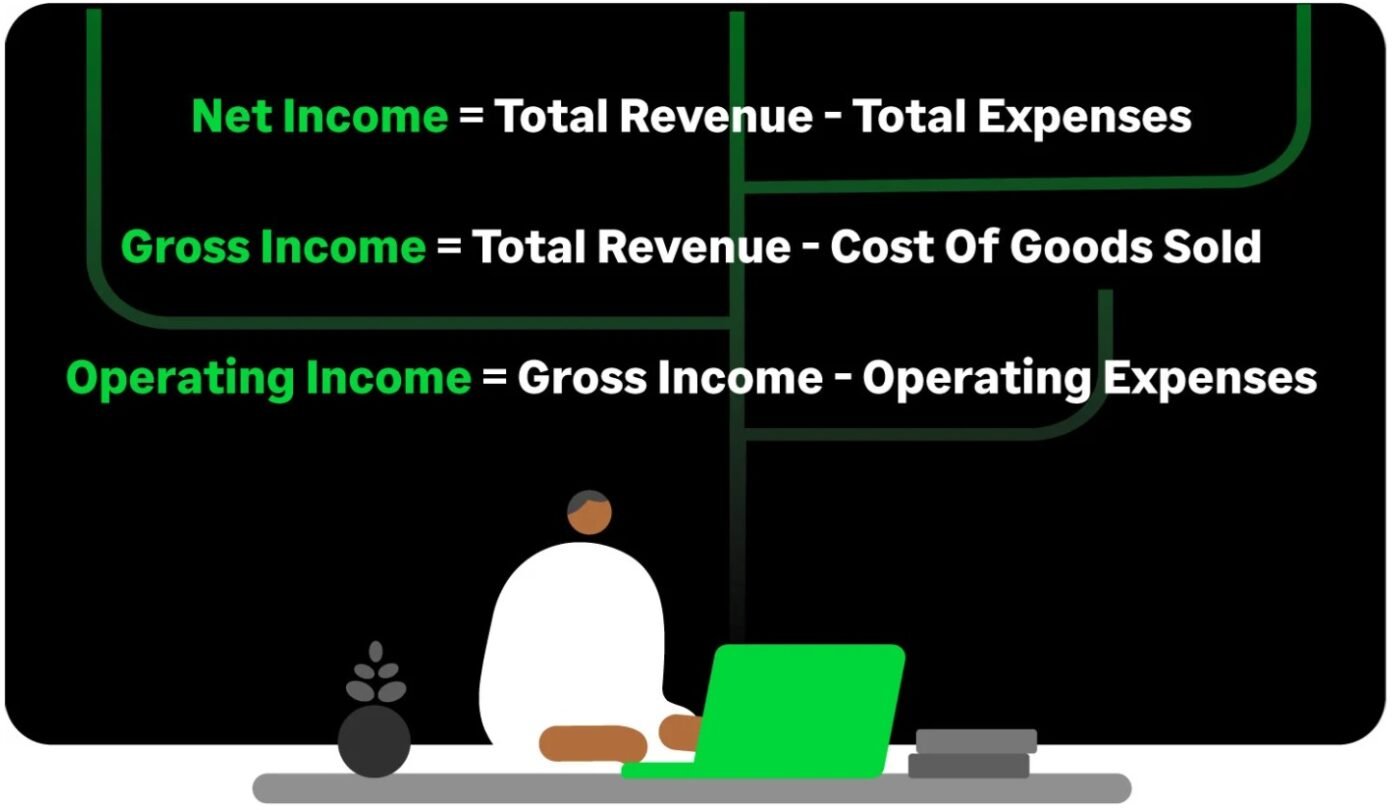
Total Revenue – Cost of Goods Sold – Expenses = Net Income

Another, simpler way of expressing the net income formula is:

Total Revenue – Total Expenses = Net Income

Before we continue, let’s get some basic definitions out of the way: 

  • Total revenue: The total amount of money your business brings in from selling your products or services over a certain period.
  • Cost of goods sold (COGS): Direct costs associated with producing or acquiring the goods and services (this might include raw materials or manufacturing costs, or the cost of purchasing inventory). Cost of goods sold is an expense.
  • Total expenses: This is the sum of the amount spent to run your business. Operating and other expenses include things like National Insurance contributions, payroll, rent, utilities, office supplies, taxes, and bank fees.
  • Gross income: Gross income, also known as gross margin or gross profit, is your total income from all sources. Minus COGS, but before deducting any operating expenses and taxes.

Net income formula example

To better understand how the net income formula works, let’s go through a quick example using both formulas. 

Imagine you run a retail store that brings in £500,000 in total revenue for the year.

Your COGS for the same year is £200,000.

Your operating expenses like rent, employee salaries, utilities, and supplies add up to £160,000.

On top of that, you pay £11,000 in taxes and £9,000 in interest.

Here’s how you’d calculate the store’s net income using the formula.

Total Revenue – Cost of Goods Sold – Expenses = Net Income

Total Revenue = £500,000 

Cost of Goods Sold (COGS) = £200,000

Gross income = £300,000

Expenses = (£160,000 + £11,000 + £9,000) = £180,000

Net Income =  £500,000 – £200,000 – £180,000 =£120,000

Total Revenue – Total Expenses = Net Income

Using the second net income formula (Total Revenue – Total Expenses = Net Income), you would calculate it as follows:

Total Revenue = £500,000

Expenses = (£200,000 + £180,000) = £380,000

Net Income = £500,000 – £380,000 = £120,000

Net income for the year under review will be £120,000.

This is the amount your business has made after subtracting all expenses.  

Where is net income shown on an income statement?

The income statement (a ledger showing money in versus money out) starts with total revenue at the top and then works its way down, subtracting expenses in each category.

After all the calculations, you end up with net income at the bottom. Hence, the expression: “bottom line”

This layout gives you and your stakeholders a clear view of how revenue turns into profit, showing exactly where every expense chips away at the final net income figure.

How to calculate net income from the balance sheet

Net income usually doesn’t appear directly on the balance sheet.

The balance sheet is more about showing what your business owns (assets), owes (liabilities), and what’s left for the owners (equity), at a certain point in time.

Net income, on the other hand, tracks your profits over a period and is typically found on the income statement.

But don’t worry, you can still calculate net income using balance sheet information.

Although the best way to calculate NI is by using your income statement, you can still use this method when the income statement isn’t available.

Here’s how you can do it:

  1. Find your retained earnings: This sits in the equity section of your balance sheet and shows the cumulative profits your business has made over time, minus any dividends paid out to shareholders.
  2. Calculate the change in retained earnings: Compare the beginning and ending retained earnings for the period. The difference will tell you how much net income has been added to your business.
  3. Account for dividends paid: If your business paid dividends during the period, add that back to the retained earnings difference. Why? Because dividends come out of net income, so adding them back gives you the true profit for the period.

The resulting formula looks like this:

Ending Retained Earnings – Beginning Retained Earnings + Dividends Paid = Net Income

Here’s an example to put it in perspective:

Suppose you started the year with £300,000 in retained earnings.

Had £450,000 at the end of the year.

During that period, you also handed out £50,000 in dividends.

£450,000 – £300,000 + £50,000 = £200,000

Based on the figures on your balance sheet, your net income for the year is £200,000.

A huge benefit of using reputable accounting software is that it can simplify this process by automatically tracking retained earnings, dividends, and net income across reporting periods.

It ensures accuracy, reduces manual calculations, and provides instant access to both balance sheet and income statement data for deeper financial analysis.

What’s the difference between net income and gross income?

Net income and gross income are both important profitability metrics, but they measure different aspects of a business’s financial performance.

In simple terms, gross income (also known as gross profit or gross margin) is the total money you make from selling goods or services, before subtracting other expenses.

It’s calculated by deducting the direct costs of producing goods or of providing services (COGS), from total revenue

Gross Income = Total Revenue – Cost of Goods Sold (COGS)

For instance: Say, your total revenue is £500,000 and your COGS is £200,000, then your gross income would be £300,000.

Gross income matters because it shows how much money you’re making from core business activities before expenses like taxes and interest.

It’s a key measure of how profitable and efficient your business is, and it helps you calculate other important numbers, like net income and taxes.

Net income? That’s the “take-home” cash, the amount you actually get to keep after all the bills are paid.

It’s what’s left after subtracting all costs from gross income, including operating expenses, interest, taxes, and any other costs (but before subtracting dividends).

Net income gives you the full picture of how profitable your business is and it helps stakeholders gauge the long-term viability of your company.

What’s the difference between net income and operating income?

Net income and operating income are both crucial for understanding your business’s financial health.

But when it comes to financial analysis, they give you insight into different things.

Operating income, also called EBIT (Earnings Before Interest and Taxes), shows the profit you make from your core business activities, before factoring in taxes and interest.

It’s calculated by subtracting operating expenses from gross income.

Operating Income = Gross Income – Operating Expenses

For example, if your business generates £500,000 in revenue, has £200,000 in COGS and £150,000 in operating expenses, your operating income would be £150,000.

Operating income is useful because it lets you evaluate the profitability of your day-to-day operations without the noise of taxes and interest, giving you a clearer view of how well your core business is performing.

Net income, as we mentioned earlier, is your business’s total profitability.

It includes operating income but also factors in non-operating expenses like taxes, interest, and any one-time costs or gains.

So, it’s the measure of how much money you actually made after everything is accounted for.

What’s the difference between net income and EBIT and EBITDA?

Net income, EBIT (Earnings Before Interest and Taxes), and EBITDA (Earnings Before Interest, Taxes, Depreciation, and Amortisation) are all important profitability metrics, but they each give you different insights into your business’s performance.

EBIT focuses on the profit generated from your core business activities, excluding the impact of interest and taxes.

This gives you a clearer picture of how efficiently your business is operating without factoring in how it’s financed or taxed.

EBIT = Revenue – (COGS + Operating Expenses) 

Alternatively, you can calculate EBIT by adding interest and taxes back to net income:

EBIT = Net Income + Interest + Taxes

For example: If your business has a net income of £120,000, interest expenses of £10,000, and taxes of £20,000, your EBIT would be £150,000.

EBIT is especially useful for comparing profitability across companies with different tax rates and financing structures because it focuses on operating income only.

EBITDA takes it a step further by also excluding non-cash expenses like depreciation and amortisation.

By removing these non-cash charges, EBITDA gives you an even more accurate look at a company’s operational cash flow, particularly in industries with large capital investments that lead to significant depreciation.

EBITDA = Revenue – (COGS + Operating Expenses + Non-Cash Expenses)

Or, you can calculate it by adding depreciation and amortisation to EBIT:

EBITDA = EBIT + Depreciation + Amortisation

Say your business has an EBIT of £150,000 and £30,000 in depreciation and amortisation.

Your EBITDA would be £180,000.

Investors and analysts will often use this metric to compare a company’s cash flow from operations, especially when businesses have different asset bases and depreciation rates.

Net income provides the best picture of profitability because it includes all expenses.

Operating, non-operating, taxes, interest, and even one-time costs or gains, so it reflects the true bottom line.

Net Income = EBIT – (Interest + Taxes)

Why is net income an important measurement of financial health?

Net income is one of the most important ways to gauge how healthy your business is financially.

Here’s why it matters:

Comprehensive profit picture

Unlike gross or operating income, net income includes every cost: operational, financial, and tax-related.

This gives you the full picture of your profitability, showing exactly how much you’re making after all expenses are covered.

Shows resource management

Net income measures how much money you’re bringing in and also how well you’re managing resources.

A strong net income means your business is balancing revenue with expenses and keeping non-operating costs like taxes and interest in check, and making the most of operational spending.

Decision-making power

Net income helps guide your decisions, whether it’s reinvesting in growth, expanding operations, or entering new markets.

Plus, a healthy net income is a good sign to investors, showing that your business has a stable financial position and strong returns.

Valuation insight

Net income is often used in business valuations, especially for calculations like price-to-earnings (P/E) ratios commonly used in UK equity markets.

Buyers, investors, and lenders look at net income to understand how much cash flow your business generates after all costs.

A higher net income leads to a higher business valuation, making it easier to secure loans or attract buyers.

Track performance over time

Analysing your net income year-over-year helps you spot patterns, identify profitable and lean periods, and adjust your strategies accordingly.

It’s an essential tool for understanding where you stand financially and knowing when to make changes.

Compliance and reporting

Net income is a critical number for compliance and financial reporting.

In the UK, net income is reported in accordance with UK GAAP or IFRS, as required by HMRC and Companies House.

It’s reported on the income statement, which means it’s necessary for keeping up with legal and regulatory standards.

Financial health cornerstone

Ultimately, net income is a touchstone of financial health that tells you how much profit is left after all expenses.

It acts as a guide for profitability, growth potential, and big-picture business decisions.

Keeping an eye on net income is especially important if your business is in expansion mode or if you’re looking to attract investors.

What are the limitations of net income?

Like every metric, net income has its limitations.

Here are some of the realities for business owners to keep in mind:

Net income doesn’t equal cash flow

Net income is a handy benchmark for determining “How is my business doing?”, but it doesn’t always reflect the actual cash moving in and out of your business.

Because net income follows accrual accounting, it records revenue and expenses when they’re earned or incurred, not when the cash is actually received or paid.

For example, if you make a sale on credit, the revenue shows up in your net income right away, even though you won’t receive payment until the following month.

So, while your net income looks higher for the period, your cash balance stays the same until the payment hits your bank account.

On top of that, net income includes non-cash items like depreciation and amortisation, which affect profitability on paper, but don’t touch your actual cash flow.

That’s a big deal because if your cash flow isn’t in good shape, you could have a high net income but still struggle to pay your bills.

The lesson there is, cash (flow) is king. Without it, even a profitable business can run into trouble.

It doesn’t capture all expenses

Net income doesn’t always paint a full picture of business expenses.

This is because some costs, like future liabilities, might not show up in your net income until they’re confirmed.

For example, contingent liabilities such as potential legal fees from an ongoing lawsuit can arise and affect your financial performance, but they’re not recorded until they become certain.

When certain expenses are left out, your business might look more profitable than it actually is.

It’s important to remember that not all costs are accounted for in net income, so you will want to dig a bit deeper to make sure you have a complete picture.

Subject to accounting assumptions

Net income can be heavily influenced by accounting rules and assumptions, and that’s something you need to keep in mind.

Different accounting methods like how you handle depreciation, when you recognise expenses, or how you value inventory can change your net income.

For example, accelerated depreciation spreads costs over a shorter period, which is better for industries with assets that lose value quickly.

On the other hand, straight-line depreciation spreads costs evenly, which works for businesses with long-lasting assets.

Inventory valuation methods, such as First-In, First-Out (FIFO) and Last-In, First-Out (LIFO), can also affect your COGS and net income.

During inflation, LIFO generally results in higher COGS and lower net income, but as it’s not allowed under International Financial Reporting Standards (IFRS), it can make comparing your numbers a bit complicated.

And let’s not forget about revenue recognition, whether you recognise revenue when it’s earned or when it’s received, can impact your perceived profitability.

For medium-sized businesses, failing to understand these factors could lead to misconceptions about your financial health.

What you see in your net income might not be the full story, as it’s dependent on the accounting assumptions driving those numbers.

Can be influenced by one-time items

Net income can be affected by one-off events that don’t represent your business’s normal operations.

Sometimes you might see a big spike in net income due to a one-time gain, like selling an asset.

While that boosts your numbers for the year, it doesn’t reflect how well your company is running day-to-day.

On the flip side, if you pay a large restructuring charge, it could lower net income in that period, but that charge might be necessary for long-term growth.

To get a clearer picture of ongoing performance, many businesses turn to adjusted net income or non-UK GAAP earnings, which exclude these one-time items and focus only on regular operations.

Doesn’t indicate operational efficiency alone

Net income alone doesn’t tell you how efficiently your business is running.

If you want to evaluate that, metrics like gross income, operating income, or EBITDA are more useful because they focus on your core business operations without the distraction of taxes, interest, or accounting adjustments.

Take control of your finances with accurate net income tracking

Calculating your net income will help you know how your business is doing.

It shows you whether you’re turning a profit, keeping expenses in check, and staying on track with your financial goals.

Knowing how to calculate net profit gives you control, but keeping it accurate and consistent can feel like a lot of work.

That’s where we step in.

Sage accounting software takes the guesswork out of your financials by handling calculations, tracking expenses, and generating financial statements automatically.

By automating the process, you’ll make better decisions and free up time to focus on growing your business.

With Sage, managing your finances becomes simple, so you can scale with confidence.

FAQ

Does net income include taxes?

Net income does not include taxes.

Net income is the profit remaining after all expenses, including taxes, have been deducted from total revenue.

Is net profit the same as net income?

Yes, they are the same.

While “net income” is commonly used in financial statements, “net profit” is used interchangeably in business discussions to describe the same concept.


Automotive

Agen Togel Terpercaya

Bandar Togel

Sabung Ayam Online

Berita Terkini

Artikel Terbaru

Berita Terbaru

Penerbangan

Berita Politik

Berita Politik

Software

Software Download

Download Aplikasi

Berita Terkini

News

Jasa PBN

Jasa Artikel

Simple steps to smart growth in 2026


Running a small business has never required more resilience.

Rising costs, digital compliance deadlines, new expectations from customers and suppliers — it can feel like the ground is constantly shifting beneath your feet.

That’s why on 5 November, from 1–1:45pm, Sage is hosting a free webinar — Small business, big savings: Simple steps to smart growth in 2026 — alongside Smart Energy GB, Allica Bank, and the Federation of Small Businesses (FSB). It’s designed to give you clear, practical guidance you can act on straight away.

Register now to reserve your seat. This article lays out the core topics we’ll be covering, so you can get ahead of the curve.

Here’s what we discuss:

1. Making Tax Digital: What it means for you

From April 2026, Making Tax Digital (MTD) requirements begin to apply to sole traders and landlords with gross income over £50,000, It applies to those with gross income above £30,000 from 2027, and then gross income over £20,000 from 2028.

Even if you’re not directly impacted yet, it may affect how your suppliers invoice you or how you share financial data.

In the webinar we’ll discuss issues like:

  • Why manual spreadsheets are problematic when it comes to meeting the new mandatory digital record-keeping requirements, and the requirement to use MTD-ready software.
  • How digital submissions at least quarterly are mandatory, along with a new digital tax return — and late filings risk penalties.
  • Why teams may need basic digital training to stay compliant without stress.
  • How MTD-ready accounting software will bring with it smart bookkeeping that saves more than time — it reduces errors and improves your financial visibility.

If you’re not yet tracking your finances in a digital system, now is the moment to get ready — before deadlines create pressure. You should be looking at upgrading your accounting software, or consulting with your accountant and bookkeeper.

2. AI in accounting: Freeing up time when it matters most

AI is about removing repetitive admin that gets in the way of growth. Tools like Sage Copilot can already help businesses to the following, and it’s only getting better:

  • Get paid up to seven days faster with automated invoice chasing.
  • Save five or more hours a week by handling manual data entry and reconciliation.
  • Begin to automate emerging requirements, such as carbon data classification and digital reporting.

As AI becomes fixed within day-to-day accounting via tools like Copilot, the businesses that benefit most will be the ones who understand where it fits — and where the human eye and expertise still matter. Trust in your financial data will become just as important as speed.

AI can be found in many products, especially agentic AI, in which the AI is proactive and informs you of problems before they’re obvious. Start investigating this technology now, and seek recommendations from professionals. We’ll dig down into more about how you can adopt AI – and its benefits – in the webinar.

3. Smart Energy management: Reducing cost through visibility

Energy is still one of the biggest overlooked overheads for small businesses. Without visibility, it’s nearly impossible to plan, budget, or spot waste.

That’s where smart meters and energy data come in. In our webinar Smart Energy GB will discuss this and how, by tracking real-time usage, you can:

  • Identify peak-cost periods and adjust around them.
  • Improve cash flow forecasting based on accurate energy trends.
  • Spot wastage that builds up quietly over time.

If you’re not yet using energy data to inform business decisions, Smart Energy GB will explain in the webinar how small changes make a measurable difference. You can also read our recent Sage guide on smart energy management for a deeper dive.

In the webinar we’ll discuss issues like using smart meters, seeking flexible tariffs, shifting high-energy tasks to off-peak, and more.

4. Finance and the Growth Guarantee Scheme: Rethinking borrowing

Borrowing doesn’t just fund expansion. It can be used to cut long-term costs. Whether it’s solar installation, electric vehicles or insulation to lower bills, financing upgrades can improve your margins.

Specialist lenders like Allica Bank are reshaping access to finance for established small businesses, and the Growth Guarantee Scheme is designed to make borrowing more accessible.

We discuss more in our webinar but action to take now include exploring funding options outside high street banks and speaking to your accountant or a specialist broker about preparing your financials for lending.

Finance is becoming a strategic tool, not just a last resort.

5. Carbon reporting: From optional to expected

37% of SMBs have already been asked to provide carbon data when bidding for work, and this number is rising across both private and public procurement.

That means even small suppliers are being assessed not just on price and delivery, but on impact transparency.

Carbon reporting doesn’t need to be complex. With the right approach, it can be automated alongside your financial processes. If you bid for contracts — or plan to — starting now will put you ahead, rather than blocking opportunities in 2026.

We discuss in our webinar how the right software for carbon accounting is essential, and can build on top of existing accounting data you already have. So, a first step is to start investigating this kind of software, and the benefits it can bring, as well as the methodologies that you can use.

Final thoughts

This is one of the most uncertain times for businesses we’ve seen in recent times. While there’s no way to control world events, it is possible to try and be prepared for whatever the future brings. That’s what our webinar is about – and you’re invited.

Small business, big savings

Register now for our free webinar that shows you simple, sustainable steps to cut costs, save time, and strengthen your competitive edge in 2026.

Reserve your place


Automotive

Berita Olahraga

Lowongan Kerja

Berita Terkini

Berita Terbaru

Berita Teknologi

Seputar Teknologi

Berita Politik

Resep Masakan

Pendidikan

How much does it cost to open a gym?


Fitness is your passion—now it’s time to make it pay the bills.

Opening your own gym is an ambitious and rewarding venture, but the biggest question is: “how much does it cost to open a gym?” Gym startup costs vary greatly depending on the size and type of operation you want to run.

That’s why we’ve created this worksheet and companion guide to determine the cost to set up a gym and calculate the details of what it will take.

Here’s what we’ll cover:

Breaking down gym startup costs

So, how much does it cost to start a gym? To answer that, you’ll first have to figure out what kind of gym you have in mind, and where.

A modest studio gym in a small town might cost significantly less to get off the ground than a mid-sized or large gym in an affluent suburb or urban area.

That said, as a rough estimate, you can expect an initial investment of £75,000-£120,000 in upfront costs to open your gym.

And how much does it cost to build a gym from the ground up? For that, you’ll have to raise the financial estimates by a wide margin.

Take into consideration factors such as square footage, location, and whether or not you’ll rent or own the gym you’re building.

Your costs could range from several hundreds of thousands of dollars—all the way up to several million pounds in some cases.

If you’re franchising, a typical initial investment can range from £19,950 (low-end) to between £1.7 million and £3.8 million for a high end establishment.

Regardless of your particular business path, it’s helpful to break down the costs into two categories: one-time startup costs and recurring costs.

One-time costs

Make no mistake, the initial costs of opening a gym aren’t cheap.

However, your wellness venture may or may not need to consider every item on this list, so feel free to pick and choose the applicable items and add them to your worksheet.

Physical location

This cost will vary greatly depending on desired size and location of your gym, as well as your decision to rent or purchase the building.

Aside from space for weights and machines, you may wish to include space for cardio, yoga, or spin classes. Additionally, you might provide locker rooms, showers, and a sauna.

If you’re buying, you will most likely need to cover a deposit of 25% of the property value, with average amounts ranging from around £21,250-£407,978 (plus additional taxes and renovations).

Average rental deposits (six months of rent) are in the range of £2,304 – £68,472.

Gym equipment

This cost similarly has a large range, depending on the amount and type of equipment you want.

As a rough estimate, your you’ll likely need to spend around £40,000 to buy equipment for 20 members.

Be sure to shop around—and keep in mind you can often get a discount if you purchase the equipment in sets as a complete package.

Licences, permits, and certifications

There is no specific, overarching licence needed to open a gym, but you will need to register your business.

Registering as a sole trader or a business partnership is free, whereas registering a limited company costs £50 online.

You might need various other licences and permits, including planning permission (if you’re changing the use of a building), music licencing (if you plan to play music in the gym), and a food hygiene permit (if you will be selling or preparing food and drink).

You’ll also want to make sure you comply with health and safety regulations, including doing risk assessments and having the appropriate insurance in place.

Don’t forget to check that the personal trainers and other gym staff you hire are properly qualified.

You may need professional help negotiating your lease, closing the property sale, or just muddling through the necessary licences and permits for your gym.

Expect to pay around £200 per hour for these services.

Point of Sale (POS) system

You’ll need to get set up with a POS system to accept customer payments, as well as proper gym management software to keep your business running smoothly.

You can expect to pay around £20-£200 per handheld card reader, and anywhere from £250 to over £1,000 for a countertop terminal or full till system.

Signage

Here’s an opportunity to get creative and this cost will vary a lot based on your specifications, like size, design, and materials used.

As a rough average, you should count on spending between £450 and £3,000 for a 1m x 5m shop sign that’s suitable for external use.

Employee uniforms

This is another cost that is entirely up to you.

You generally want some uniformity across staff wardrobe, but for a gym, simple workout clothes and company logo shirts are typically the norm.

If you’re planning on supplying your team with a few polo shorts or t-shirts and perhaps a hoodie or jacket, with your logo on them, £30-£80 per staff member might be a realistic ballpark cost.

But it could be less or significantly more, depending on the uniform requirements and quality.

Merchandise

Don’t overlook a great opportunity to offer customers supplies and merchandise. Think t-shirts, supplements, protein shakes and powders, water, etc.

Make sure you budget in the cost of the initial stock.

As an example, a startup stock of merchandise—including 50 branded t-shirts, 20 branded hoodies, 100 branded plastic sports bottles, and 50 branded microfibre gym towels—would be around £1,700 – £2,000, depending on the exact quantities, quality choices, and complexity of branding.

Marketing and advertising

You’ll want to announce your arrival to attract potential customers.

The average cost of a multi-channel marketing campaign to announce the launch your gym could range from around £7,000 to £72,000 or more, including the set-up cost of a new, responsive website.

Your total will depend on which marketing channels you prioritise, but they could include digital adverting, a content and SEO strategy, and targeted local or regional print and broadcast adverting.

Contingency budget

It’s a good idea to make sure you have a contingency fund in place to cover normal business costs and any unforeseen expenses.

Aim to have enough reserve funds to cover three to six months of operating expenses.

Recurring and ongoing costs

Since the ongoing cost of owning a gym varies so significantly between gym types and sizes, we’ve made a list of potential costs for you to consider in your venture.

Exact figures may be more or less for your operation, but these average gym operating cost categories should be on your mind.

While there are a lot of expenses to keep track of here, these can be easily managed using expense tracking software.

Mortgage or lease payments

Regardless of whether you rent or purchase the property your gym is based in, you’ll have a monthly expense in the form of a mortgage or lease payment.

Costs will vary significantly depending on the factors outlined above and the final cost of the building or loan amount.

Insurance

You’ll need public liability insurance and employers’ liability insurance and professional indemnity cover.

You should also consider buildings or commercial property insurance, as well as contents or specialist equipment insurance.

It’s a good idea to invest in cover for business interruptions as well.

You can expect to pay a minimum of around £1,000 per year for a small gym with four employees, but depending on the cover you need, your insurance could easily cost £1,500-£3,000 or more per year.

Equipment lease payments

If you choose to go the leasing route for your equipment, make sure to budget for those payments.

As a general estimate, you would potentially be looking at around £2,500 per month for a full commercial gym setup, catering to 200 members.

Utilities

A gym uses a lot of electricity, especially if it’s open 24 hours a day. You could easily be looking at around £2,000 per month for utilities.

Equipment repairs and maintenance

Gym equipment takes a beating day in and day out. Make sure you factor in repair and maintenance costs in your budget.

This could cost you anywhere from around £1,000 per year for a smaller gym to £11,000 or more for larger gyms.

Cleaning supplies

Cleanliness and sanitation is a must for a gym. You’ll need mops, vacuums, toilet paper, bleach, wipes, laundry service, etc.

For an average-sized gym, you can you can expect to pay somewhere in the region of £200-£300 per month, based on bulk buying.

HVAC maintenance

This is your heating and air conditioning, and it’s pretty important upkeep for a gym.

Generally, the maintenance cost can range from around £50 to £200 per unit, depending on the type of system you have and the service that’s needed.

Internet and Wi-Fi

Your customers will appreciate free Wi-Fi. The average price of business broadband in the UK is around £40 per month.

POS software

In terms of payment and business management software, solutions typically range from around £20 to £200+ per month.

Employee wages

Employees will earn varying salaries depending on their skills and experience levels.

Make sure you have payroll for the first few months on hand before opening—it may take some time to turn a profit.

Credit card processing fees

Business credit card processing fees typically range from 1.5% to 3.5% of the transaction amount.

Marketing

It’s up to you if you want to make your marketing efforts an ongoing cost.

You’ll have to consider your individual business model and measure the return on investment of different marketing strategies. Most businesses spend 2-5% of their revenue on marketing.

This is a fluctuating expense, as it depends on your particular business model and situation.

Just keep in mind that professional services, such as accounting or legal, typically cost around £200 per hour at least.

Common gym startup myths & mistakes

Every gym startup operation is different, saddled with its own unique set of challenges to face.

You’ll have to accept that you’re bound to make some mistakes. Our advice: just make sure to avoid these common missteps.

  1. Don’t skip the training and accreditation. As a fitness professional, your clients look to you as an authority, so make sure that’s the truth. Proper training and accreditation is key to the success of your clients’ goals and therefore the success of your gym as a business. You aren’t serving your clients or yourself if you and your staff are not properly trained. Accreditation in niche or specialty fitness markets is also a great way to set your gym apart from competitors.
  2. Don’t begin without a client base. If you’re considering opening your own gym or fitness centre, you most likely already have a number of clients. A gym is a tough business to start from scratch, so you really want to make sure you have a sustainable number of devoted clients who will become members. If you don’t have any sure clients at the outset, don’t invest in opening your own gym at this stage—work on building your client base on a smaller scale.
  3. Don’t skimp on equipment quality. Across the board, you want to make sure your equipment and facilities are up to snuff—if not for your members, then for your own bottom line. Gyms take a lot of abuse and going cheap on flooring will cost you more in the long run when you have to replace it. Buying used machines may be less expensive at the time, but you’ll sacrifice access to the full manufacturer’s warranty coverage, as well as up-to-date technology to best serve your members.
  4. Don’t surprise your neighbours. There’s going to be some noise. Weights will be heavy, music will be pumping, machines will be whirring—even downstairs neighbours of a zen yoga studio will hear some thumping. If your space is connected to, or within earshot of, others you’ll want to be fully upfront about the inevitable noise with your landlord and neighbours. The last thing you want is for your business to have a negative impact on its surrounding area, so make sure you clear this issue early on.
  5. Don’t forget about the gym management software. Naturally, you’ll want your gym to operate smoothly and efficiently. A lot goes on behind the scenes with each membership. Sophisticated software to handle check-ins, billing schedules, membership renewals, day-to-day scheduling, and various other administrative tasks may not be cheap, but it’s worth every penny. Remember: automation is your friend.

How to use the gym startup cost worksheet

Our gym startup cost worksheet is easy and intuitive to use. Once downloaded, it’s fully customisable to fit your needs.

The template includes some high and low-end estimates for starting a gym to get the ball rolling.

  • Download the free template.
  • Add or remove fields applicable to your particular gym startup type.
  • Assess your needs and related costs.
  • Make a note of costs that might change or costs to be determined.
  • Plug in your numbers and enjoy the simplified breakdown of your startup and ongoing costs.

Sage lets you focus on building your business, not tracking expenses

Opening and maintaining a gym requires a lot. Day in and day out you invest your time, energy and focus into creating something amazing.

So why waste your valuable time and efforts tracking expenses the old-fashioned way?

Administrative tasks can now be fully automated—so upgrade your business model with Sage Accounting.

You have enough on your plate and our online accounting software can save you time and money. Outsource the busy work and get back to doing what you do best—making your business a success.

Additional startup cost templates

Is our sample gym startup cost calculator not what you’re looking for? Please check out our other templates. We also offer solutions for all of your startup needs.

Restaurant startup cost calculator
Food truck startup cost calculator
Beauty salon startup cost calculator
Bar startup cost calculator

Important information about these gym startup costs

The startup costs shown here by industry are merely guidelines and average estimates based on information pulled from a variety of sources. While we have attempted to present the most accurate information available, please be aware that startup costs can vary greatly according to a number of factors, including but not limited to your location, local fees, and contractor quotes. The information presented here is intended to help guide prospective business owners in the search for information on starting a business within a given industry, but should not be interpreted as an exact quote.

Sage provides the information contained here as a service to the public and is not responsible for, and expressly disclaims all liability for damages of any kind arising out of use of, reference to, or reliance on any information contained on this site. While the information contained on this site is periodically updated, no guarantee is given that the information provided is correct, complete, and up-to-date. Sage is not responsible for the accuracy or content of information contained on this site.


Automotive

Berita Olahraga

Lowongan Kerja

Berita Terkini

Berita Terbaru

Berita Teknologi

Seputar Teknologi

Berita Politik

Resep Masakan

Pendidikan

Cash flow statement template (download for Excel)


As one of the 3 main financial statements, a cash flow statement is an essential tool for understanding a company’s financial health, assessing its liquidity, and confirming how much cash it has on hand.

Along with the balance sheet and income statement, this set of financial documents are required for both private and public companies.

 A standard cash flow statement format encompasses three main sections: operating activities, investing activities, and financing activities.

 This guide will cover not only a cash flow statement template, but also how to prepare your cash flow statement, what to include in the three main sections, and how the direct and indirect methods differ.

We’ll also cover IAS 7 requirements for cash flow statements, including recent changes companies should keep in mind.

For more information, you can also read cash flow statements explained here.

To prepare a statement more efficiently, download our free cash flow template.

Here’s what we’ll cover

Completing the main sections of the cash flow statement

To prepare a cash flow statement, follow these six steps:

1. List the opening balance

Begin by listing the opening balance of cash and cash equivalents for the reporting period.

This figure should equal the closing balance from the previous reporting period.

The starting balance can be placed at the top or the bottom of the statement.

This section can use either the direct or the indirect method.

  • When using the direct method, record all cash received and all cash paid. Then, calculate the total.
  • When using the indirect method, start by listing the company’s profit or loss for the reporting period (under IFRS, which applies to UK companies). Then, take steps to reverse the effect of the accruals. Adjust for elements like depreciation and amortisation, and then calculate the total.

Under IFRS, companies may choose from several different starting points when using the indirect method.

Options include:

  • Profit or loss
  • Profit or loss before tax
  • Operating profit or loss
  • Profit or loss from continuing operations

List cash inflows and outflows from operating activities:

  • Receipts from goods or services sold: Add any cash receipts from goods (for a product-based company) or services (for a service-based company).
  • General operating and admin expenses: Subtract any cash payments to suppliers for goods and services related to the company’s core business activities. Also include office expenses, rent and utilities for the company’s facilities.
  • Wage expenses: Subtract any cash used to pay the company’s employees, executives and directors.
  • Income tax payments: Subtract any cash used to pay for the company’s income tax.
  • Other operations: Add any cash receipts that fall outside of the core business activities. Such as license income, the share of profits from joint ventures or grant monies received.
  • Depreciation and amortisation adjustments: Add in the value of any depreciation and amortisation to undo the effect of these accruals.
  • Change in inventory: Subtract the value of any increases in inventory or add the value if inventory has decreased.
  • Change in operating assets: Subtract the value of any increases in operating assets such as accounts receivable and monies owed to the business or add the value if operating assets have decreased.
  • Change in operating liabilities: Add the value of any increases in operating liabilities such as accounts payable or subtract the value if operating liabilities have decreased.

Note that the process is similar to that for calculating the change in operating assets but that the process is reversed.

In the next section, list cash received and paid from investing activities.

Tally all cash inflows and outflows related to buying and selling property and assets that increase the value of the business.

Note that IFRS allows for interest and dividend receipts to be included in either investing or operating activities.

The classification of these receipts must be consistent between reporting periods.

  • Receipts from the sale of property and equipment: Add any cash received from selling assets such as property and machinery.
  • Collection of loans: Add in cash from receiving financing from investors, mortgages or loans.
  • Proceeds from disposal of investments: Add in any cash received from the sale of marketable securities, or other investments such as contracts or IP rights.
  • Purchase of property and equipment: Subtract any investments in assets such as property and machinery.
  • Loans to others: Subtract payment of monies in the form of loans made to others, typically subsidiary companies.
  • Purchases of investments: Subtract any cash paid from purchasing marketable securities, or other investments such as contracts or IP rights.

Here, list the cash received and paid from financing activities.

Tally all cash inflows and outflows from fundraising and repaying debts that allow the company to operate or grow.

Note that IFRS allows for interest and dividend payments to be reflected in either financing or operating activities.

Their classification must remain consistent between reporting periods.

  • New banks loans: Add any cash received from bank loans or other creditors.
  • Proceeds from issuing common stock: Add any cash received from the sale of equity, stock, or bonds.
  • Repayment of bank loans: Subtract any cash paid to repay loans and debt, either from investors, mortgages or the bank.
  • Dividend and interest payments: Subtract any cash paid to pay dividends and interest. Under IFRS, dividend and interest payments may be classified as operating activities instead.

5. Determine the total change in cash

Calculate the total change by adding together the operating, investing, and financing activities.

This figure reflects the total increase or decrease in the company’s cash and cash equivalents.

6. Calculate the cash at end of year

Finally, determine the ending balance. Add or subtract the increase or decrease in cash and cash equivalents to the starting balance for the cash flow statement’s reporting period.

A positive balance indicates that the company has more cash flowing in than out.

A negative balance confirms that the company has more cash flowing out than in.

The difference between direct and indirect cash flow statements

Both IFRS and HMRC allow the direct or the indirect method of calculating operating activities.

While both methods provide the same end result, they have several important differences.

Direct method Indirect method
Accounting method Uses cash accounting, which tallies cash when it’s received or paid Uses accrual accounting, which tallies cash when it’s earned
Starting point for calculating operating activities Not applicable; simply lists cash inflows and outflows from operating activities Starts with profit or loss under IFRS; starts with net income under GAAP
Estimated work level Tends to be higher, as it requires listing all cash transactions Tends to be lower, as it works back from the income statement
IFRS requirements Must reconcile net income to net cash flow from operating activities None
GAAP requirements Must reconcile net income to net cash flow from operating activities None

IAS7 requirements for cash flow statements

IFRS uses IAS7 (International Accounting Standard 7: Statement of Cash Flows) for preparing cash flow statements.

Below are some requirements to keep in mind when using this standard.

Operating, investing, and financing activities

Any company using IFRS standards must analyse cash flows using 3 types of activities:

  • Operating activities: Focus on cash received and paid from revenue-producing activities
  • Investing activities: Focus on acquiring and disposing long-term assets and investments
  • Financing activities: Focus on borrowing funds and repaying debts

Direct method for reporting operating activities

For the direct method for reporting operating activities, IAS7 requires reconciling net income to net cash flow from operating activities.

This extra step aligns the statement of cash flows with the income statement.

Indirect method for reporting operating activities

IFRS also allows the indirect method for reporting operating activities. IAS7 requires using profit or loss as the starting point.

As of 2024, companies may define this starting point in one of several different ways.

However, IAS7 requires a standard starting point for reporting periods starting January 1, 2027 (read more below).

Reporting investing and financing activities

IAS7 requires companies to report most investing and financing activities gross, categorised by type of receipt or payment.

However, this standard requires certain activities to be reported net, including:

  • Cash received or paid on behalf of customers
  • Cash received or paid for items in large amounts, with rapid turnover, and with short maturities
  • Cash received or paid related to financial institution deposits

Dividend and interest payments and receipts

IAS7 allows some flexibility when reporting dividend and interest activity.

Both may be considered operating activities.

Companies have the option to consider dividend and interest receipts as investing activities instead.

Companies may also consider dividend and interest payments as financing activities.

However, IAS7 requires companies to maintain consistent classification between reporting periods.

Disclosures

Non-cash investing and financing doesn’t appear on the cash flow statement.

However, IAS7 requires companies to disclose these activities in other financial statements.


Recent IAS7 changes to cash flow statement preparation (2024)

A recent amendment to International Financial Reporting Standards (IFRS), issued in April 2024, means that for annual periods starting on or after 1 January 2027, companies must use the operating profit or loss subtotal as the starting point for the indirect method in cash flow statements.

If your business chooses to adopt this change early, it’s important to clearly disclose this decision in your financial statements, following IFRS guidance.

This update aims to make cash flow statements more consistent and easier for investors to compare.


Cash flow statement templates

Cash flow statement template

Download our cash flow statement Excel templates

Download now


What are the 3 main sections of a cash flow statement?

Whether a company uses IFRS (International Financial Reporting Standards) or GAAP (generally accepted accounting principles), a cash flow statement consists of three main components:

Operating activities

Operating activities refer to the company’s primary revenue-producing activities.

Think of them as standard business activities that generate cash inflows and outflows.

Revenue covers cash coming into the business from goods and services, and out of the business to wages, operating expenses and income tax payments.

Investing activities

Investing activities refer to investments the company makes using cash, not debt.

However, for investment companies, investments are reflected in the company’s operating activities.

Investing activities cover buying and selling long-term assets.

The buying and selling of investments such as IP rights or contracts and the collection and issuance of loans from the business to subsidiaries of the company.

Financing activities

Financing activities refer to cash investments in the company.

They include cash inflows from raising funds and cash outflows from repaying debt.

Cash flow from financing activities can come from receiving financing from investors, issuing payments to shareholders or repaying debt principal.

What are cash and cash equivalents?

Cash flow statements reflect a company’s balance of cash and cash equivalents at the beginning and end of the reporting period.

These statements also show the total change from the beginning to the end of the period.

Cash

Cash includes both currency and demand deposits.

The latter refers to money held in bank accounts from which the depositor can withdraw at any time without significant financial risk or penalty.

In addition to domestic currency, cash can also include foreign currency.

The value of any foreign currency should reflect the exchange rate on the date the company received the cash.

Cash equivalents

Cash equivalents are investments designed to meet short-term cash commitments.

These highly liquid investments have a maturity date of 3 months or less after acquisition.

In addition, they can easily convert into known cash amounts.

As a result, cash equivalents have a very low risk of changes in value.

Cash equivalents can include:

  • Money market funds, government bonds, and corporate bonds that meet the definition above and maintain an insignificant risk of changes in value
  • Shares that were acquired just prior to maturity and that have a firm redemption date
  • Bank overdrafts that are part of the company’s cash management strategy, meaning the company regularly fluctuates between positive and negative demand deposit balances

What’s the difference between an income statement and a cash flow statement?

As two of the three main types of financial statements, both cash flow and income statements offer insight into a company’s financial performance.

Yet they do so from different perspectives.

Cash flow statements

Cash flow statements confirm how liquid a company is.

They reflect cash paid and received, revealing how much cash a company has on hand at the end of a reporting period.

Income statements

Income statements also called profit and loss (P&L) statements confirm how profitable a company is.

They reflect revenue and expenses accrued during a reporting period, including non-cash accounting like depreciation and amortisation.

What isn’t included in a cash flow statement?

A cash flow statement doesn’t reflect:

  • Debt instruments that have a maturity date of more than 3 months after acquisition and that carry significant risk of changes in value.
  • Most shares as they have a significant risk of changes in value and they aren’t convertible to a preset amount of cash.
  • Cryptocurrency and gold because they aren’t readily convertible to predetermined amounts of cash.
  • Restricted cash and cash equivalents that a company can’t readily access because of legal restrictions or financial controls, such as funds owned by a subsidiary.
  • Non-cash transactions that don’t have a direct effect on a company’s cash inflows or outflows

What’s the difference between GAAP and IFRS for cash flow statements?

GAAP and IFRS use similar guidelines for preparing cash flow statements.

However, the way the two accounting standards classify cash flow activities differs.

IFRS considers the nature of the activity when classifying cash flow.

If using the indirect method, GAAP will use items from the income statement (net income, depreciation expense, etc) to prepare the cash flow statement.

Here are several ways these differences affect cash flow statements:

Bank overdrafts

If your business uses bank overdrafts that are repayable on demand and these overdrafts are part of your regular cash management, IAS 7 allows you to include them as cash equivalents in your cash flow statement.

This means that when your cash balances often move between positive and negative, you can show these overdrafts alongside cash and other cash equivalents, giving a clearer picture of your day-to-day cash position.

Restricted cash

IFRS requires companies to disclose restricted cash (i.e., inaccessible balances held by the company’s subsidiary) in the cash flow statement.

UK IFRS requires restricted cash to be disclosed separately in the notes to the financial statements.

Dividend and interest receipts

IFRS allows dividends and interest paid to be classified as operating or investing activities.

UK IFRS allows flexibility in classifying dividend and interest payments, which may be treated as operating or financing activities depending on the company’s policy.

Dividend and interest payments

IFRS allows dividends and interest paid to be classified as operating or financing activities.

Under UK IFRS, companies may classify dividend and interest payments as either financing or operating activities, provided the classification is applied consistently across reporting periods.

Discontinued operations disclosures

IFRS requires companies to disclose cash flow from discontinued operations either in the cash flow statement or in its notes.

UK IFRS requires companies to disclose cash flows from discontinued operations either within the cash flow statement or in accompanying notes, ensuring transparency for investors.


Sage financial reporting software can help with your reporting and the management and growth of your business.

Our cash management software also automates tasks and provides real-time, reliable cash flow visibility.

Sage Intacct has 150 built-in financial reports enabling you to easily create custom reports and leaving you with more time to focus on your business and prepare your financial statements.


Cash flow statement template

Download our cash flow statement Excel templates

Download now


Automotive

Berita Olahraga

Lowongan Kerja

Berita Terkini

Berita Terbaru

Berita Teknologi

Seputar Teknologi

Berita Politik

Resep Masakan

Pendidikan

Cash flow statement explained | Sage Advice UK


A cash flow statement offers a clear view of your business’s financial health, showing how well it’s performing during the current reporting period and over time. 

Whether you’re a small business owner, an entrepreneur planning for growth, or part of an accounting team keeping payroll and bills on track, understanding your cash flow is essential.  

Financial statements are vital for informing decision-making for leadership, investors, and creditors. 

Cash is the lifeblood of your company, so the management team needs to monitor the cash flow at all times to ensure survival balanced with growth. 

This guide covers what a cash flow statement is, what it shows, how to read it, and how to prepare one that supports better planning.  

It also explores why it’s a must-have tool for anyone doing market research, considering new opportunities, or assessing business performance over time. 

To get a head start, you can also download our cash flow template.

Here’s what we’ll cover

What is a cash flow statement?

A cash flow statement is a simple report that discloses your business’s cash outflows and inflows during a reporting period. 

It highlights where the cash came from and how it was spent, giving you a real-time picture of your business’s financial activity.  

It also helps you confirm whether your business can meet its everyday expenses and pay off any debts. 

Also known as a statement of cash flows, this document is one of the three core financial statements every business needs—alongside the balance sheet and the income statement (often called the profit and loss account). 

We’ll compare these three reports in depth below, but essentially: 

  • Cash flow statements show how much your business has on hand and how it’s being generated and used. 
  • Balance sheets show your business’s assets, liabilities, and equity. 
  • Income statements show your business’s profitability. 

Cash flow statements follow standardised formats and formulas. 

In the UK, the format of your cash flow statement depends on the accounting standards your business follows. Most businesses use one of the following:  

If your business follows IFRS, your cash flow statement must comply with International Accounting Standard 7: Statement of Cash Flows (IAS 7), which outlines how to report cash movements during a financial period.  

What is a cash flow statement used for?

This financial statement serves several purposes for internal and external decision makers: 

  • Creditors may use it to assess your organisation’s liquidity (e.g. the amount of cash on hand to meet short-term obligations). 
  • Investors may use it to measure your company’s financial health and inform their valuation. 
  • Shareholders may use it to monitor the strength of their investments over time 
  • Accounting staff may use it to confirm whether your business can cover essential outgoings like payroll, tax liabilities, and overheads. 
  • Potential hires and stakeholders (such as suppliers and customers) may view strong cash flow as a sign of financial stability, which can help build confidence in your business.  
  • Market research may use it to assess the state of the market and the performance of their direct or indirect competitors. 

Because cash flow statements follow standardised reporting rules (such as FRS 102 or IFRS), they also work well as comparative tools. For example, you can use them to: 

  • Compare two or more companies within the same industry or market. 
  • Track a single company’s performance over several months or financial years. 

Cash flow statements can be produced monthly, quarterly, or annually, depending on your reporting needs. 

This is why accurate general ledger reconciliation is critical; even small errors can distort your overall cash picture. 

If your business is listed on the London Stock Exchange (including AIM), you’ll need to include cash flow statements in your financial disclosures under IFRS.

These disclosures are also subject to audit requirements and regulatory review under the UK Companies Act and IFRS, ensuring accuracy and compliance with legal standards.

This standardisation makes the cash flow statement a cornerstone of external accountability, especially in public markets. 

What does a cash flow statement show you about your business?

A statement of cash flow answers many important questions about the health of your business.

For example:

How liquid is your business?

This statement tells you exactly how much cash your business has on hand at the end of the reporting period.

It confirms if you can pay debts and operating expenses in cash.

What are your biggest sources of cash inflow and outflow?

The simplicity of this report makes it easy to see which activities contribute most to your business’s income and expenses.

How is your cash flow likely to look in the future?

You can compare multiple consecutive statements to identify patterns, anticipate future cash flow, and make data-driven decisions about business plans.

Is your business likely to receive financing?

Investors and lenders often review cash flow to make decisions about providing loans, lines of credit, and funding.

What should a cash flow statement include?

Cash flow statements follow a structure that lists your business’s operating, investing, and financing activities.

Each activity type appears in a dedicated section. This way, it’s easy to see which has the biggest impact on your business’s cash flow.

After listing your business’s activities, the statement shows the total increase or decrease in cash and cash equivalents. A positive number reflects a net increase, while a negative number reflects a net decrease.

The statement also includes the opening balance of cash and cash equivalents for the reporting period.

This figure equals the closing cash balance for the previous period and can be placed either at the top of the statement or at the end with the closing balance.

At the end of the statement is the closing balance of cash and cash equivalents for the current reporting period.

This closing balance figure will become the opening balance for the subsequent reporting period.

Cash flow statements also disclose non-operating non-cash activities, such as renegotiating debt as a debt/equity swap.

The placement of non-cash disclosures depends on the accounting standard your business follows:

  • Under FRS 102, these transactions may also appear in the notes to the financial statements, rather than within the body of the cash flow statement itself.
  • Under IFRS (IAS 7), non-cash investing or financing activities are typically disclosed in a footnote to the cash flow statement.

The 3 main activities of a cash flow statement

Every cash flow statement includes three main sections. Each details a specific type of cash inflow or outflow.

Operating activities

Operating activities refer to standard business activities.

This section of the statement shows how much cash your company generates through its core operations, such as selling products or providing services.

Cash from operating activities includes:

  • Selling goods or services
  • Paying suppliers and vendors
  • Making interest or income tax payments
  • Paying wages or salaries to employees
  • Making rent payments for company facilities

Note:

Interest received and interest paid may be classified differently depending on the accounting standard.

Under IFRS, interest paid can be classified as either operating or financing, and interest received can be classified as either operating or investing.

FRS 102 allows similar flexibility, but classifications should be applied consistently.

Investing activities

Under IFRS, loans made to subsidiaries or third parties, as well as repayments received, are typically classified as investing activities.

This section reports cash used for or generated from acquiring or disposing of long-term assets, investments, or subsidiaries.

Cash flow from investing activities includes:

  • Purchase or sale of property, plant, and equipment (PPE).
  • Under IFRS, loans made to subsidiaries or third parties, as well as repayments received, are typically classified as investing activities.
  • Purchasing marketable securities such as IP rights, or contracts.
  • Acquisition or disposal of subsidiaries or business segments.

For investment companies, investing is part of doing business. In this case, any cash paid or owed for investments appears in the operating activities section.

Financing activities

Financing activities refer to  transactions that result in changes to the size and composition of a business’s equity and borrowings. 

This section of the cash flow statement shows how much cash your company generates from raising funds and repaying debt.

Cash flow from financing activities includes:

  • Proceeds from loans or issuance of equity (e.g., shares).
  • Repayment of loan principal
  • Dividends paid to shareholders
  • Repaying debt principal.
  • Making payments to shareholders.
  • Purchase or redemption of company shares.

Note:

Under IFRS, interest paid can be classified as either financing or operating activity, depending on your company’s policy and disclosure.

What are cash equivalents?

A cash flow statement includes both cash and cash equivalents.

Cash equivalents are short-term, highly liquid investments that can easily be converted into cash, typically with a maturity of three months or less and minimal risk of value fluctuation.

Some examples of cash equivalents include:

  • Currency
  • Bank accounts
  • Treasury bills
  • Short-term government bonds

Both the opening and closing balances in a cash flow statement include cash and cash equivalents.

You can prepare a cash flow statement using either the direct or indirect method for operating activities—both are permitted under FRS 102 and IFRS.

IFRS tends to encourage the indirect method, especially for larger businesses, but you have the flexibility to choose the approach that fits your reporting needs.

Direct method

The direct method is the more straightforward of the two. It’s particularly well suited to businesses using the cash basis accounting method, which is more common among smaller companies following FRS 102.

This method works like a simple cashbook, where you list and total all cash payments and cash receipts from the reporting period to calculate net cash flow.

Indirect method

The indirect method starts with net profit and adjusts for changes in working capital.

It is more commonly used by companies applying accrual accounting and preparing full IFRS or FRS 102 accounts.

This is because the indirect method uses your company’s income statement as the starting point for calculating cash flow.

The income statement counts income and expenses when they’re accrued.

To use this method, start with the net income. Then, adjust it by adding or subtracting all non-cash items.

Asset depreciation and amortisation are some of the most common adjustments. Both of these items decrease income, but they aren’t cash expenses.

An April 2024 amendment to IFRS requires companies to begin using the operating profit subtotal as the starting point for the indirect method. This change affects annual periods starting on or after 1st January 2027.

It’s important to note that cash flow statements do not include non-cash transactions such as depreciation, amortisation, or stock adjustments.

These are excluded because they do not represent actual cash movements

How to read a cash flow statement

When reviewing a cash flow statement, finance professionals typically look for one of two outcomes:

  • Does your business have positive cash flow (more cash coming in than going out)?
  • Or is it showing negative cash flow (more cash going out than coming in)?

It’s important to remember that a cash flow statement captures your cash movements over a defined reporting period, not a snapshot at a single point in time.

To get a fuller picture of your business’s financial health, you should always compare multiple statements over different reporting periods.

 Comparing cash flow statements over time reveals whether your business is expanding, contracting, or undergoing a transition.

In more serious cases,  persistent negative cash flow may indicate financial distress or a risk of insolvency.

Negative cash flow

A statement showing negative cash flow indicates your business is spending more cash than it’s receiving.

Although this outcome may seem undesirable, it doesn’t always signal a serious problem.

Your business’s growth or funding stage may negatively affect cash flow for a limited time.

While cash flow may be negative during this period, ideally, the trend will reverse.

As an example, additional context or deeper analysis may reveal that your business is undergoing rapid growth or expansion.

In addition, early-stage startups often have a higher burn rate before becoming profitable.

Positive cash flow

A statement showing positive cash flow indicates your business is bringing in more cash than it’s paying out.

On a surface level, more cash flowing in than out reflects a financially healthy business.

However, positive cash flow doesn’t always equal a profitable business.

As a result, it’s essential to review your company’s income statement and balance sheet to analyse the underlying factors.

As an example, your business can achieve a positive cash position by taking out a large loan to mitigate cash flow problems.

This position may be temporary—and it may reverse once the repayment period begins.

Some fluctuation is inevitable. But businesses with uneven cash flow over multiple reporting periods often appear unstable.

Investors may view their risk level as too high and decline to fund them.

Cash flow statement vs. income statement vs. balance sheet

As useful as cash flow statements are, they only tell part of the story of your company’s financial health.

To gain a comprehensive view of financial health, it’s important to review the cash flow statement alongside the income statement and balance sheet.

Cash flow statement

This statement reflects the reality of your company’s cash position at the end of the reporting period.

It details what happened to the cash and whether your company has enough on hand to operate effectively.

It only includes cash inflows and outflows that have already occurred.

A cash flow statement doesn’t include credit-based sales or other income or expenses that haven’t yet flowed into or out of your business.

As a result, income statements and cash flow statements can show seemingly contradictory results.

An income statement may show a profit if your business has incurred substantial income, while a cash flow statement may show negative cash flow if your business has spent more cash than it received.

Income statement

An income statement serves as the starting point for the indirect method of calculating cash flow.

Also called a profit and loss (P&L) statement, it reflects your company’s net income at the end of the reporting period. It shows the cumulative effect of all revenue and expenses.

It includes several components that don’t factor into cash flow, such as credit-based sales and depreciation.

Neither of these line items reflect cash flowing into or out of your business.

That’s because the accrual method that most businesses use records income when it’s earned and expenses when they’re incurred. Often, this timing doesn’t align with when the cash arrives or leaves the account.

Balance sheet

A balance sheet reflects your company’s financial position at a specific point in time, showing what it owns and owes.

Think of this financial statement as a report that calculates your company’s value.

It reveals your company’s available resources, including assets, liabilities, and owner equity. In other words, it tallies how much your company owns and how much it owes.

This report doesn’t include revenue, expenses, or cash inflow and outflow.

The differences between UK GAAP and IFRS

Businesses typically prepare their financial statements under either FRS 102 or IFRS, depending on their size, complexity, and reporting obligations.

Both frameworks require a cash flow statement as part of the financial statements (except for certain small entities under FRS 102 Section 1A), but there are some key differences in how these statements are structured.

Here’s how FRS 102 and IFRS differ when preparing cash flow statements:

1. Cash equivalents

Under IFRS (IAS 7), cash and cash equivalents include short-term, highly liquid investments with maturities of three months or less from the date of acquisition, subject to minimal risk of changes in value.

FRS 102 adopts a similar definition but allows slightly more flexibility in how cash equivalents are interpreted and disclosed, especially for entities not applying full IFRS-level disclosure requirements.

2. Classifications of interests and dividends

IFRS allows flexibility in classifying interest and dividends as operating, investing, or financing activities.

From 1 January 2027, amendments to IAS 7 will mandate the use of a single classification approach for interest and dividends, enhancing consistency across reporting entities.

FRS 102 is less prescriptive and allows more discretion, provided classifications are applied consistently.

3. Bank overdrafts

Both IFRS and FRS 102 allow bank overdrafts repayable on demand to be included in cash equivalents if they form part of daily cash management.

4. Method of preparation

Both standards allow the direct or indirect method to calculate cash flows from operating activities

IFRS encourages the indirect method, especially for larger or listed companies.

FRS 102, often used by smaller businesses, is more flexible. Many SMEs opt for the direct method due to its simplicity.

Cash flow statement example

This example illustrates how a typical cash flow statement looks.

You can download a cash flow statement template here.


To help you prepare your financial statements, Sage Intacct has 150 financial reports that allow easy access to your financial information.

With Sage financial reporting software you can create custom reports to help with your reporting, leaving you more time to focus on the management and growth of your business.

You can also have a real-time visibility into your financial data through Sage cash management software, which help you create accurate forecasts and build financial plans confidently.


This article was verified by UK and Ireland-based Certified Public Accountant (CPA). Accounting rules are complex and change frequently and we recommend you seek any accounting advice from a qualified CPA.


Automotive

Berita Olahraga

Lowongan Kerja

Berita Terkini

Berita Terbaru

Berita Teknologi

Seputar Teknologi

Berita Politik

Resep Masakan

Pendidikan

5 reasons to start Making Tax Digital for Income Tax early


Can you remember exactly what you were doing in March 2024? Probably not. So why should you be expected to remember every business transaction from that far back?

But HMRC’s Making Tax Digital for Income Tax (MTD) is set to change this.

MTD marks a fundamental shift in how you record and report your tax, and, by April 2026, it will be mandatory for sole traders and landlords with gross annual income over £50,000.

Here’s what we talk about in this article:

Why starting early with MTD makes sense

MTD expert and accountancy practice owner Rebecca Benneyworth is encouraging early adoption:

“By leaving it until April 2026, the pressure will really be on – especially for those getting to grips with new software and working with accountants and bookkeepers for the first time”.

Here’s what she has to say:

Getting started early isn’t just about compliance. It’s about saving time, money, and stress in the long run.

Intrigued about getting ahead of the curve? Here’s five reasons why starting MTD early makes sense for your business.

1. Avoid the admin headache

Picture this: it’s tax season. You’re surrounded by old receipts, mismatched invoices, and endless bank statements from the last 18 months, all while the submission deadline looms.

For many sole traders, landlords, and small business owners, this is the familiar reality of Self Assessment.

That’s why it could be time to get ahead with MTD.

Starting MTD early helps you move from reactive to proactive bookkeeping. Instead of scrambling once a year, your records stay current, meaning your year-end process is simply about confirming, not rebuilding.

Here’s how MTD makes that easier:

  • Digital record-keeping: Store income and expenses digitally, not in piles of paper.
  • Quarterly updates: Spread your workload throughout the year, catching errors early.
  • Categorisation: Many MTD-compatible tools use AI to automatically tag transactions.

By the next tax season, you’ll have everything ready and organised, while others are still digging through boxes.

2. Get better control of your cash flow

When you file just once a year, tax estimates are often guesswork. Underestimate and you’ll face surprise bills; overestimate and you tie up cash you could use elsewhere.

MTD can help prevent that. By keeping your records updated quarterly, you’ll have a real time view of what’s coming in and going out. This allows you to:

  • Spot upcoming cash shortfalls before they happen.
  • Build tax reserves gradually.
  • Identify spending spikes early.

That means, if a tenant leaves unexpectedly, or a big, unexpected cost hits, you’re not caught out. Because you’ve had your finger on the pulse all year, you’re better able to absorb disruptions. You can borrow or budget proactively instead of reactively.

3. Drastically reduce the risks of mistakes and fines

From incorrect categorisation to forgotten expenses, human error can happen, and sending one big year end tax return makes mistakes harder to spot. Instead, think of getting ahead with MTD as your own early warning system.

MTD means you’ll be doing partial updates throughout the year which gives you the chance to catch any mistakes early. By starting now, you’ll have more time to become accustomed to the software that can flag anomalies missing categories, duplicated entries, or large expenses, all while still being in control.

And, with HMRC’s ‘testing period’, you can familiarise yourself with all of this before MTD is compulsory and at a time where penalties for late quarterly updates are suspended. Now is the perfect time to learn and adjust, without the pressure of ‘getting it right’.

Think of MTD as your own built-in error detection system. You’ll catch and fix issues in real time, not months later – reducing your risk of fines, HMRC investigations, or sleepless nights.

4. Gain deeper insights for better decision-making

When your financial records live only in a year-end return, it’s easy to lose visibility over how your business is evolving. Trends, expense leaks, underperforming properties – all these factors can remain hidden until it’s too late.

Starting MTD early lets your accounting system become a living dashboard, and, because you’re logging and reviewing all year, patterns can emerge in:

  • Profit margin trends per property or business segment
  • Expense domains that might be inflating (maintenance, utilities, admin)
  • Seasonal variations in cash flow
  • Underused deductions or tax relief
  • Unusually high expense categories that deserve investigation.

HMRC recognises this advantage, noting that MTD helps taxpayers to “see your predicted tax bill year-round and make more informed financial decisions.”

Suppose you manage two rental properties and over several quarters, you see that one property’s maintenance and repair costs are creeping above 20% of its rent, while the other remains stable at 5%. That insight gives you oversight of your finances where you may only notice it at year end.

Rather than losing time, you’ll have the decision advantage well in advance.

5. Reduce stress and gain peace of mind

Running a small business or managing multiple properties can be overwhelming, especially when tax deadlines loom. Last-minute scrambles, missing receipts, or unexpected bills create not just financial headaches, but real stress.

Starting MTD early changes that.

By keeping your records up to date and reviewing them quarterly, you create a calm, predictable rhythm to your finances. You’ll be able to:

  • Approach tax season without panic, knowing your data is already organised.
  • Avoid the late-night number-crunching and last-minute problem-solving.
  • Free up mental space to focus on growing your business or enjoying time off.
  • Build confidence in your financial decisions, knowing nothing is slipping through the cracks.

With MTD, your accounting becomes less of a yearly chore and more of a manageable, ongoing task. The result isn’t just better finances – it’s less stress, more control, and the reassurance that you’re on top of your business all year round.

Final thoughts

Switching to MTD early isn’t just about compliance. It’s an investment in your business’ future. You’ll have the clarity, confidence, and control long before the deadline arrives.

By the time MTD becomes mandatory for nearly everyone in 2028, you’ll already be compliant and ahead of most other businesses. So why wait for the deadline to loom when you can take control today?

Get ahead of Making Tax Digital

Whether you’re a sole trader, accountant, bookkeeper, small business owner, or landlord, Sage has the tools you need to start now and confidently meet MTD deadlines.

Start now with Sage


Automotive

Berita Olahraga

Lowongan Kerja

Berita Terkini

Berita Terbaru

Berita Teknologi

Seputar Teknologi

Berita Politik

Resep Masakan

Pendidikan